
AI chatbots & conversational AI: The evolution from an FAQ bot to artificial intelligence
Five years ago, chatbots still worked with rigid rules and limited answer options. Today, they conduct complex sales calls, recruit new employees and solve IT tickets independently. The technological revolution through generative AI has turned rigid scripts into intelligent interlocutors.
Anyone looking for AI chatbots today will find a full-fledged ecosystem: from specialized customer service bots to sales assistants to HR tools that automate the entire onboarding process. The technology behind it — Conversational AI — enables machines not only to recognize words, but also to understand context and intent. Natural language processing (NLP) plays a central role in precisely analyzing and interpreting human language. This article shows how the technology has developed, which fields of application are currently the most relevant and where AI-based chatbots provide real added value.
From FAQ bot to conversational AI: What's changed
The development of chatbots can be divided into two clear generations. The difference between the two is significant.
The first generation: rule-based chatbots
The first chatbots were based on fixed rules and keyword recognition. They worked according to the principle: When users write “opening hours,” show the predefined answer A. As soon as someone formulated a question differently or had several concerns, the system reached its limits.
These rule-based systems were rigid, unable to provide context and only offered limited opportunities for interaction. Contacting customer service was often perceived as time-consuming — exactly the problems that early chatbots could not solve.
The second generation: AI-based chatbots
With the breakthrough of Natural Language Processing (NLP) and Natural Language Understanding (NLU), this has fundamentally changed. Modern AI chatbots understand not only individual keywords, but the entire context of a request. They recognize the intent behind a message, even if it's written colloquially, incorrectly, or ambiguously.
The basis for this are large language models such as GPT-4, Claude or Gemini, which have been trained on billions of texts. These AI models enable chatbots to have real conversations. They have a contextual understanding over several rounds of conversation, the ability to ask questions when things are unclear, and provide natural, human-like answers.
As a result, current systems solve a significantly higher proportion of routine queries without human help, while early chatbots often failed with simple deviations from ready-made paths.
Which AI chatbots are there? Overview by use case
The market for conversational AI has grown significantly in recent years. There is a wide variety of solutions available. Choosing the right technology depends heavily on the intended use.
Customer Service & Support
Specialized platforms such as Zendesk AI Agents, Intercom and Ada dominate customer service. These systems are designed to understand customer inquiries, automatically answer standard questions, and forward complex cases to human employees.
The most advanced solutions can access backend systems, think through scenarios, and adapt in real time. The AI understands the problem, examines solutions and then carries out actions. They work across various channels such as chat, voice, email and social media.
Sales & lead generation
In sales, AI chatbots help qualify leads, guide prospects through the sales funnel and make appointments. Platforms such as Drift, HubSpot Chatbot, and Qualified are optimized for exactly these use cases.
An example: An AI-supported sales chatbot can specifically query important information, such as whether interested parties already own a product or what their requirements are. The system then automatically suggests the appropriate product page without users having to click through menus. Such chatbots provide personalized advice, accelerate the purchase decision and improve the customer experience through seamless, contextual conversations.
You can find out first-hand how SMEs successfully use chatbot solutions at the 2027 data:unplugged festival. There, companies share their specific experiences with sales automation and show what they are implementing in practice and how.
HR & internal communication
Chatbots are also gaining in importance in the human resources sector. Tools such as Workday Assistant or Microsoft Copilot automate onboarding processes, answer questions about benefits, and assist with vacation requests.
Employees receive immediate answers to standard questions, which relieves HR teams and allows them to concentrate on more complex tasks. Conversational AI also enables integration with various communication channels, such as WhatsApp, to efficiently process applicants' questions about open positions, background checks, and job interview coordination.
Industry-specific solutions
In addition, there are increasingly industry-specific AI chatbots, for example for healthcare, financial services or e-commerce. These systems are tailored to the respective requirements and compliance rules.
The rate of AI chatbots is increasing, particularly in industries such as real estate, retail, finance and healthcare. This pays off: Industry-specific chatbots understand technical terminology, know typical processes and can provide more precise answers than generalists.
Where AI chatbots create real added value
The technology is available and the providers are numerous. In these four areas, it is particularly clear why the use of AI chatbots is worthwhile.
Continuous availability
Chatbots answer inquiries around the clock, even outside business hours. This relieves support teams and improves service quality. Users appreciate continuous availability as one of the most important advantages.
At the same time, there are significant cost advantages: Companies can significantly reduce their customer service costs and improve service quality at the same time.
Scalability while maintaining quality
A human support team can only process a limited number of requests at a time. An AI chatbot, on the other hand, can make thousands of calls in parallel, without loss of quality, without waiting times and without overloading.
This is particularly valuable during seasonal peaks or product launches. The systems automatically scale with demand without the need to hire additional staff.
Personalization through data integration
Modern AI chatbots are no longer isolated systems. They integrate with CRM systems, e-commerce platforms, and knowledge databases. This enables personalized interactions. The chatbot knows the purchase history, knows which tickets are already open, and can respond specifically to individual needs.
Our master classes at the data:unplugged festival shed light on how conversational AI works in practice — directly to try out and implement. Here you can find out from experts which integration strategies really work and what you should pay attention to when implementing them.
Process automation beyond dialogs
The most powerful chatbots do more than just provide answers. They carry out actions: They book appointments, cancel orders, create tickets or request invoices. This ability to automate processes makes them true digital assistants.
Technology continues to evolve towards full process automation — chatbots are increasingly becoming the primary channel for customer interactions.
The limits of AI chatbots: What they can't (yet) do
As impressive as the progress is, AI chatbots still have clear limits. Anyone who knows these can realistically use the technology.
Complex emotions and genuine empathy remain a challenge. A chatbot can analyze and respond to sentiment, but it can't replace real human empathy. In emotionally charged situations, such as complaints, personal crises or complex consultations, human intervention often makes more sense.
Chatbots also reach limits when it comes to very specific technical questions. Although they can access knowledge databases, highly complex or very individual problems often still require human experts.
Good escalation management is therefore crucial: The chatbot must recognize when it is reaching its limits and be able to seamlessly hand over the request to human employees. The best systems combine automation with human expertise.
What is important when choosing
With all the options available, the question is: Which AI chatbot is right for your company? Six criteria are particularly important.
- Integration into existing systems: The most powerful chatbot is of little use if it can't communicate with your CRM, support tool, or e-commerce system. Pay attention to available interfaces and APIs.
- GDPR compliance & data protection: Data protection is a core issue for European companies. Where is the data processed? Which servers do the models run on? Are there clear compliance commitments? Many companies prefer AI solutions from Germany or Europe — and for good reason.
- Customizing vs. out-of-the-box: Some chatbot platforms offer ready-made solutions that are quickly ready to use. Others make it possible to make profound adjustments to specific processes. The right choice depends on your requirements and resources.
- Cost and scalability: Pay-per-use models are attractive for beginners, but can be expensive when volumes are high. Fixed cost models offer better predictability. Calculate realistically how many conversations you expect.
- Support and development: Is the provider being actively developed? Are there regular updates? How good is the support in case of problems? These questions are important because chatbots need continuous maintenance and optimization.
- Lock-in risk: How dependent do you make yourself on a provider? Open source solutions or platforms with standardized interfaces reduce the risk of being bound in the long term.
At the data:unplugged festival, SMEs exchange views on exactly these questions — Which providers are convincing in practice, where there are stumbling blocks and which implementation strategies have proven effective.
Conclusion: Chatbots have grown up
The development of rule-based FAQ bots into intelligent conversational AI systems is more than a technical evolution. It fundamentally changes how companies communicate with customers, employees and partners. Modern AI-based chatbots understand context, conduct real dialogues, automate processes and deliver measurable results. They are no longer a gimmick, but productive tools that can create added value in almost every area of the company — from customer service to sales to HR.
Not every use case justifies the use of AI. But where repetitive inquiries, high volumes and the desire for continuous availability come together, the impact is significant. Companies that invest in Conversational AI today are laying the foundation for scalable, efficient and customer-friendly processes. The technology is there. The business cases are clear. It is now a matter of strategic implementation. With realistic expectations, a clear focus and a willingness to continuously optimize chatbots.
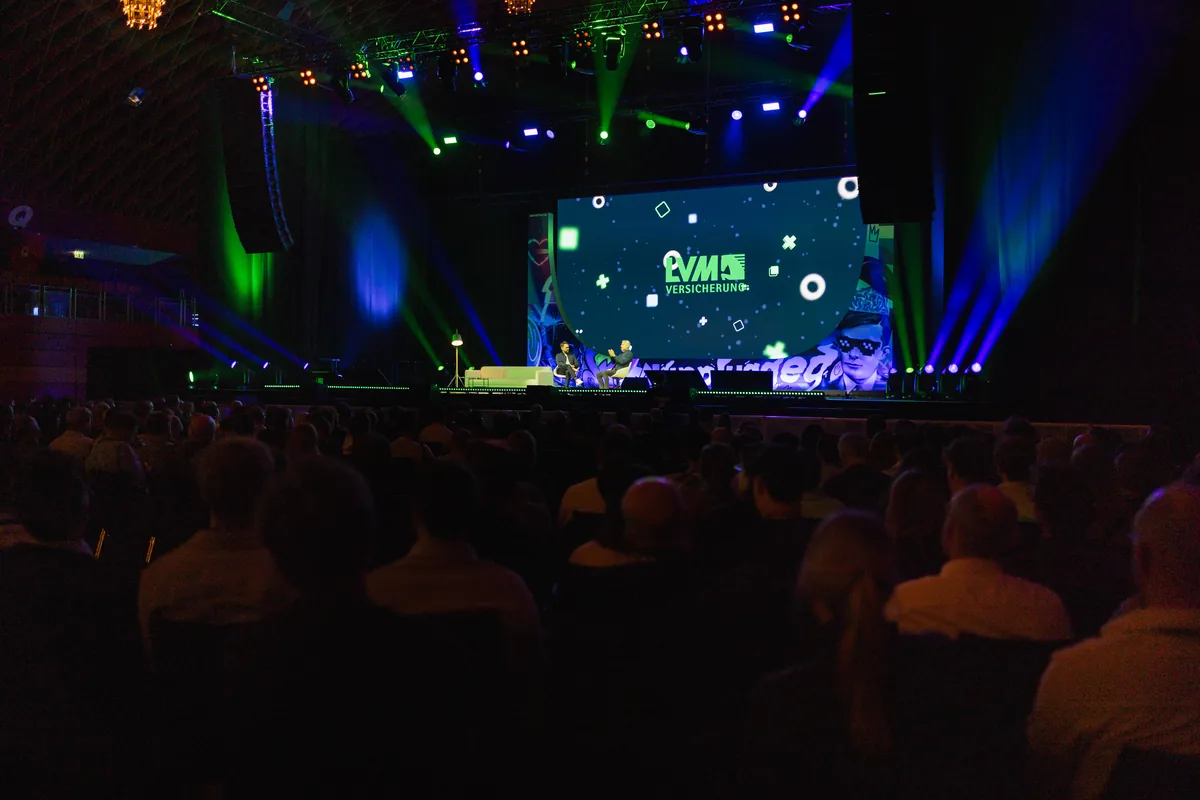
You can find out how other SMEs are successfully using AI chatbots on the data:unplugged festival 2027 on April 13 & 14 in Münster. Here, companies from a wide range of industries share their experiences in the areas of customer service, sales, HR, marketing, finance, logistics and IT. At the SME Stage, use cases on conversational AI, process automation or AI integration will be presented: from initial implementation to GDPR-compliant solutions to scaling. In addition to the SME Stage, space will be created on four other stages for exchange on well-founded practical examples of chatbots and AI in order to understand and actively shape the benefits of the technology.
AI chatbots affect all areas of the company: For effective implementation, it is crucial to involve key people in your company, train them and positively prepare them for use. data:unplugged stands for a broad and well-founded transfer of knowledge — from which the entire business team benefits. Get a ticket for yourself and your core team now!
More blogs



for the d:u27!