
The 7 most important AI trends in 2026: What decision makers need to know now
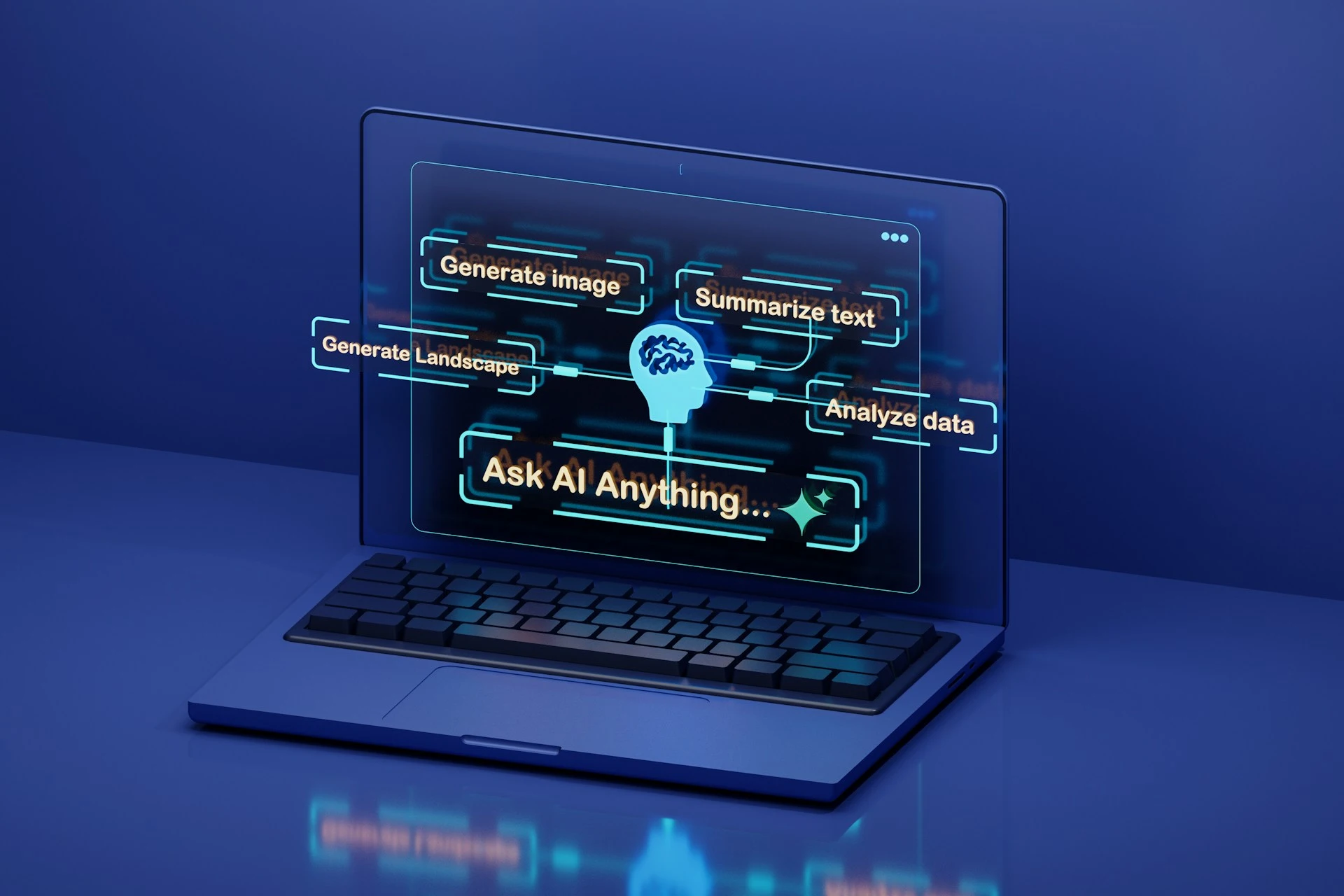
AI has arrived in SMEs. Many companies have launched initial pilot projects, tested tools or started working on the topic internally. The question for 2026 is: which developments are really relevant? And where is the step from the test phase to productive use actually worthwhile? This overview maps the most important AI trends for SMEs.
1. From pilot projects to real value creation
The most important AI trend in 2026 is not a technological one, but a strategic one: the leap from the experimental phase to productive application. Many companies are still stuck in endless pilot phases: 95 percent of generative AI projects have yet to achieve measurable ROI. The models work — but integration into business processes keeps failing.
The difference between winners and losers lies not in the technology, but in the approach. Successful companies do not start with the tool, but with a specific business problem. They identify areas with repetitive tasks — recruiting, data preparation, customer communication — and apply automation there.
For SMEs, this means: don't wait for the perfect AI project, but start with a clearly defined use case that delivers measurable results within weeks. Quick learning cycles instead of big-bang projects. Anyone who is still only experimenting in 2026 will be overtaken by competitors who are already working productively.
2. Generative AI becomes the standard in everyday business
ChatGPT, Microsoft Copilot and specialised industry solutions have penetrated everyday business life in record time. Content creation, data analysis, programming, customer communication — AI applications have long since arrived across all these areas. The productivity effects are real, and expectations are correspondingly high.
But as rapid adoption grows, so does the risk of uncontrolled use. Shadow AI — the unofficial use of AI tools without governance — is already a reality in many companies. According to Bitkom, employees in every fourth company use personal tools for work purposes — and the trend is rising. Sensitive data enters external AI systems, AI-generated content is adopted without review, and data protection and compliance requirements are overlooked.
Successful companies establish clear usage guidelines: approved AI tools for specific use cases, training for all employees, quality control processes. Balancing innovation with risk management will be a decisive success factor in 2026.
How other SMEs find this balance is on show at d:u27 on 13 & 14 April 2027 in Münster.
3. Data quality becomes a critical bottleneck
"Garbage in, garbage out" — this principle applies to artificial intelligence more than ever. The best model delivers unusable results if the underlying data is not right. A lack of data governance is one of the biggest obstacles to AI initiatives. The consequences: unreliable results, compliance risks, loss of trust among decision makers, delays and additional costs.
Regulatory requirements are adding further pressure. GDPR, the EU AI Act and the Data Governance Act require proof of data origin, documentation of training data and traceability of decisions. Companies that do not have their data quality under control will not only struggle technically in 2026 — they will also face regulatory challenges.
Before investing in AI models, the data foundation must be in place. It starts with a data assessment: which data is available, in what quality, with what governance? Anyone who wants to go deeper will find practical starting points in the article on data-driven decision-making in SMEs.
4. The EU AI Act changes the rules
The EU AI Act has been in force since August 2024 and is now taking full effect in 2026. Since February 2025, the AI competence requirement has applied: all employees who work with AI systems must have sufficient competence, regardless of company size or industry.
From August 2026, the full requirements for high-risk AI systems come into force. This includes AI in HR, lending and healthcare. Strict requirements around documentation, risk management, data quality and human oversight become mandatory for these systems.
Some relief may be on the way: the EU's "Digital Omnibus" package provides for simplifications, including extended deadlines and reduced documentation requirements for SMEs. But companies should act now. Those who meet the requirements proactively reduce legal risks and gain a head start in trust with customers and partners.
5. Talent shortages slow progress — but AI helps
A lack of AI talent is slowing down scaling in many companies. The good news: artificial intelligence itself can help ease the talent shortage. By automating repetitive tasks and boosting productivity, existing teams can achieve more. The division of roles is becoming clearer: AI systems handle routine tasks, while people step into roles as supervisors, decision makers and creative problem solvers.
AI transformation is also creating new roles and requirements. Prompt engineering, validation of AI outputs and the design of human-machine collaboration are becoming highly sought-after competencies. For SMEs, the key message is: not every role needs to be filled internally. Strategic partnerships and external expertise can close gaps. What matters is that the core team understands the technology and can apply it.
At our events, experts show how AI competence can be built up within organisations — hands-on and directly applicable. You can find out which speakers will be there here.
6. Trustworthy AI becomes a competitive advantage
In a world of increasing AI adoption, trust is becoming a key differentiator. Trusted AI encompasses several dimensions:
- Transparency in decision-making processes
- Fairness without discrimination
- Resilience against manipulation
- Explainability for users
- Clear accountability
Companies that position themselves through trustworthy AI systems gain advantages in sensitive industries such as HR, financial services and critical infrastructure. The EU AI Act provides a binding framework for this. High-risk systems face strict requirements: risk management systems, high-quality training data, technical documentation, human oversight, robustness and cybersecurity. What is still voluntary today will be mandatory tomorrow.
One often overlooked aspect: artificial intelligence is also a tool for sustainability goals. The connection between digitalisation and ESG strategy offers untapped potential — from emissions reduction to energy efficiency.
7. Ecosystems and platforms become essential
The days of companies building AI applications entirely from scratch are over for SMEs. Cloud hyperscalers such as Microsoft Azure, AWS and Google Cloud have massively expanded their offerings. For SMEs, these platforms offer low-barrier entry points: ready-made AI models, development platforms for customisation, and scalable computing capacity.
At the same time, demand for European alternatives is growing. Data protection, data sovereignty and geopolitical considerations are driving the trend towards local solutions. Alongside the major platforms, industry-specific ecosystems are emerging: data spaces for connected mobility in the automotive industry, industrial IoT platforms in mechanical engineering, AI-based supply chain networks in retail. AI agents — autonomous systems that perform tasks independently — are also gaining relevance and are increasingly being integrated into these platforms.
The decision between build, buy and partner will become a key strategic question in 2026. Not everything needs to be developed in-house — but dependency on individual providers should be managed consciously.
What these AI trends mean for SMEs
The trends paint a clear picture: artificial intelligence has broken through in the German economy. Every third company is already using AI — almost twice as many as in 2024. Now it will be decided who actually realises the value-creation potential.
For decision makers in SMEs, there are concrete areas for action:
- In the short term: build AI competence — the training requirement of the AI Act is already in force. At the same time, carry out an AI inventory: which systems are already being used in the company, officially and unofficially?
- In the medium term: establish a solid data foundation and scale successful pilots. Without a data strategy, AI projects will fail.
- Strategically: answer the ecosystem question — where to rely on external platforms, where to enter into partnerships, and where to build up in-house expertise?
German SMEs have ideal conditions for AI innovation: deep domain knowledge, a strong engineering culture, and agile decision-making. The question is no longer whether AI will be relevant — but how quickly and how strategically the transformation will be shaped.
Conclusion: 2026 is the year of decision
The most important AI trends of 2026 can be distilled into one message: from experimentation to implementation. The technology is mature, the regulation is in place, the competition is acting. Anyone who does not scale now risks falling behind.
The start does not have to be perfect. A pilot project with a clear business case, an initial dashboard for data-based decisions, training for key decision makers — that is enough to begin. What matters is that the first step happens now.
Companies share the leap from pilot to production first-hand at the d:u27 Festival on 13 & 14 April 2027 in Münster. Six stages, 350+ speakers, 80+ masterclasses and over 250 exhibitors, covering AI use cases in the enterprise, trustworthy AI and scaling AI — with decision-makers and AI leads who've already worked through the rough patches. Get your ticket for d:u27 now!
More blogs




for the d:u27!