
Knowledge management with AI: How artificial intelligence ensures knowledge transfer in SMEs
59% of manufacturing and retail workers aged 55 and over will retire in the next five years. With them, decades of experience, undocumented processes and knowledge are lost. Know-how is often stored in the minds of individuals and not in systems that secure this knowledge in the long term. There is often no targeted transfer of knowledge.
AI-supported knowledge management today offers practicable solutions for systematically recording, making available and preserving experiential knowledge in the long term. The benefits range from increased productivity to securing critical expertise.
The challenges of knowledge transfer
Loss of knowledge is a gradual process that is reflected, among other things, in extended training periods, an increased error rate and delays in projects. Many employees spend a lot of time helping colleagues with gaps in knowledge — because know-how is not documented. As a result, valuable working time is missing for actual work.
The resulting costs are significant:
- When experienced knowledge holders leave the company, it takes several months to years for successors to reach the same level of experience.
- During this time, more errors, rework and complaints occur.
- Customer inquiries are processed more slowly.
- Innovation projects are delayed.
Companies in which critical expertise is held by a few key people are particularly affected. This is often the case in medium-sized companies. For example, the production manager knows exactly which machines cause problems when there is high humidity and knows which measures can help to prevent them. The sales manager has detailed knowledge of the individual needs and characteristics of the most important customers. The IT administrator is the only one who understands the complex interrelationships of the old system and can ensure its functionality.
Why traditional methods of knowledge management are reaching their limits
Many companies already have approaches to knowledge management: documentation on the server, corporate wikis, manuals. However, these systems are often not maintained, are difficult to search and capture only a fraction of actual knowledge. The transfer of content is unsystematic.
The most valuable knowledge is often implicit. It is in experiences, assessments and contextual knowledge that is difficult to express in words. Transferring this knowledge into a static document is complex and is therefore rarely implemented. There is no real exchange of knowledge between generations.
Even when knowledge is documented, colleagues often cannot find it. They don't know which folder to search in, which keywords to enter, or whether the information even exists. As a result, you'd rather ask questions directly — and the cycle starts all over again.
How AI tools are transforming knowledge management
Artificial intelligence can solve these challenges on several levels. The use of modern AI tools is currently evolving from a theoretical promise to a practical solution that is also becoming available to medium-sized companies. This digital transformation of knowledge management comprises three core tasks.
Capture knowledge automatically
AI systems can automatically combine knowledge from various sources: emails, chat histories, project documentation, support tickets, meeting minutes. What used to have to be laboriously documented manually can now be automatically recorded and structured. Digitalizing these processes saves valuable resources.
Speech-to-text technologies make it possible, for example, to record explanations from experienced employees and convert them into searchable texts. The production manager no longer has to write down his knowledge, he can simply explain it. The AI system transcribes, structures and makes it accessible to others.
Make knowledge intelligently searchable
The real progress lies in the way AI makes knowledge accessible. Instead of searching for exact keywords, employees can ask questions in natural language: “What settings do I need for Product X when humidity is high?” The system understands the question, searches all relevant sources and provides a concrete answer, including a reference to the original source. This makes knowledge transfer a matter of course in everyday life.
This semantic search is fundamentally different from classic search functions. It understands context, recognizes connections and can also find information that has been described in other words. The transfer of knowledge is therefore continuous and comprehensive.
RAG: The bridge between AI and business knowledge
A key technology for AI-supported knowledge management is called RAG (Retrieval Augmented Generation). By definition, the concept combines the linguistic capabilities of AI models with the specific knowledge of a company and thus enables a continuous flow of knowledge.
This is how it works in practice: When someone asks a question, the system first searches the internal knowledge base for relevant information. These are then transferred to a language model, which formulates an understandable answer. This is based on real company data, not on general Internet knowledge.
The AI relies on verified internal sources. At the same time, it can create connections and combine information from various documents. As a result, the data remains internal and is not transferred to external AI services.
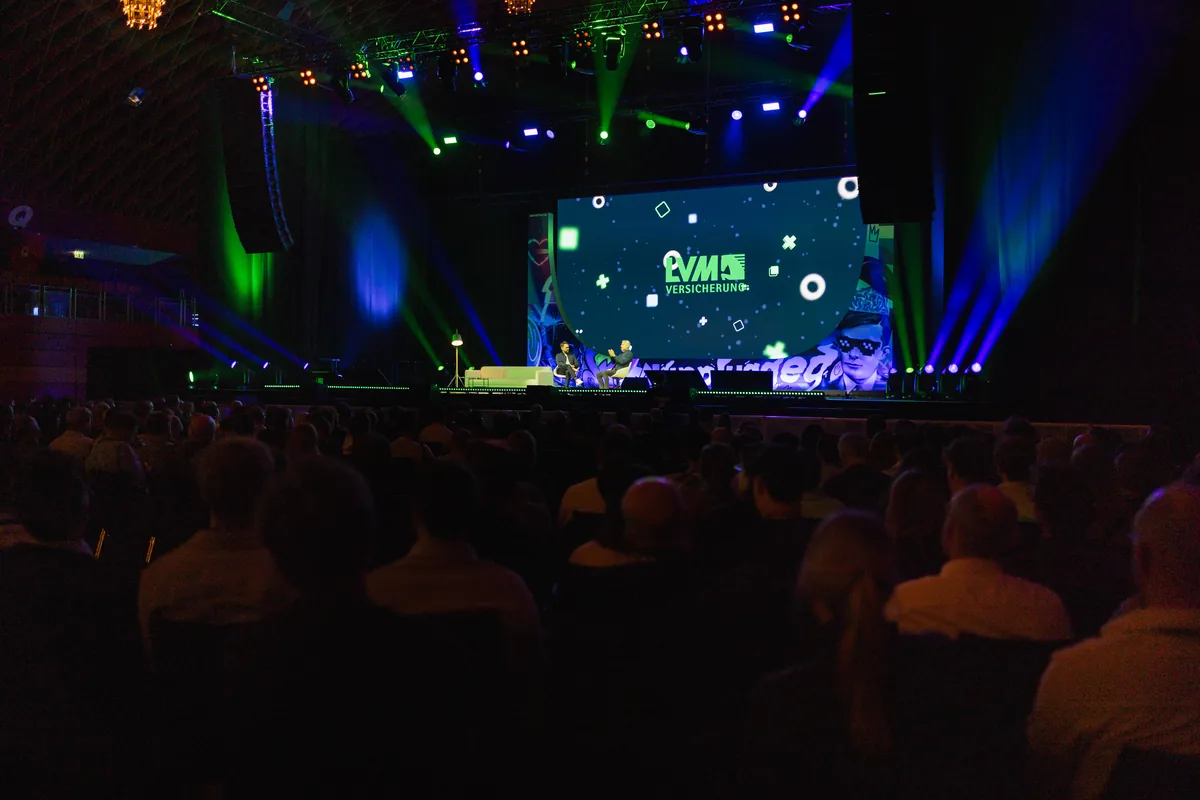
At d:u27 on 13 & 14 April 2027 in Münster you can find out first-hand how SMEs successfully implement AI-supported knowledge transfer. There, companies share their specific experiences with RAG implementations and show which approaches work in practice.
Knowledge transfer in practice: use cases in medium-sized companies
The technology sounds abstract, but it has very specific applications. Here are three examples that are particularly relevant for medium-sized companies:
Speed up the onboarding process
New employees can ask the AI system questions instead of interrupting experienced colleagues:
- How does the process for customer complaints work?
- Where can I find the proposal template?
- What do I have to consider during the quality inspection?
The system provides immediate answers from the documented knowledge base. This not only speeds up the familiarization and transfer of knowledge. It also relieves experienced employees who have previously acted as contact persons. The onboarding process thus becomes an efficient phase of learning.
Ensure knowledge transfer before leaving
Structured knowledge transfer sessions can be held before experienced people leave. AI-based systems help to ask the right questions and document the answers: Which situations are critical? Which solutions worked? Which mistakes should be avoided?
This knowledge is processed in such a way that it can be used by others. Not as a dry handbook, but as a searchable, contextual knowledge base. The transfer of knowledge is thus also successful over generations.
Improve support and communication
In technical support or customer service, employees often need to access knowledge from various sources: product documentation, previous support cases, technical specifications. An AI-supported system can combine this information and provide suitable solutions. The exchange of knowledge thus takes place in real time.
This reduces processing times and improves the quality of answers. This is particularly important when experienced colleagues are no longer available.
Which AI tools are there for knowledge management?
The market for AI-supported knowledge management tools is growing rapidly. The solutions can be roughly divided into three categories:
Integrated platforms such as Microsoft Copilot or Notion AI add AI features to existing work environments. Advantage: Integration with existing tools is easy. Disadvantage: The AI functions are often generic and not optimized for specific knowledge management requirements.
Specialized knowledge management tools such as Guru, Confluence with AI extensions or dedicated RAG solutions focus on recording and providing corporate knowledge. They usually offer better functions for structured knowledge databases, but require independent implementation.
Custom RAG implementations allow maximum control and customization. Companies can build their own systems that are tailored exactly to their requirements, including the ability to keep sensitive data completely on-premises. However, set-up and maintenance costs are higher.
A pragmatic approach is often recommended for SMEs: Start with a simple solution, gain experience and switch to specialized AI tools if necessary. The most important factor is not technology, but consistent application.
Prerequisites for successful knowledge transfer
AI-supported knowledge transfer doesn't work without basics. Before you invest in tools, you should answer three questions:
- What is the status of your data quality? AI systems are only as good as the data they work with. If your documentation is outdated, contradictory, or incomplete, the AI system won't provide good answers either. An inventory and, if necessary, adjustment of existing sources of knowledge is the first step.
- Where is your critical knowledge? Not all knowledge is equally important. Identify the areas where loss of knowledge would have the biggest impact. Who are the key people leaving in the next few years? Which processes depend on their knowledge? That's where you should start.
- What is the acceptance within the team? The best technology is useless if it is not used. People need to understand why knowledge management is important and how it actually helps them. A system that does additional work without providing any discernible benefits often fails.
At our events, you will learn from experts how to get started with AI-supported knowledge management — from data preparation to tool selection. Exchange with other medium-sized companies at work level is also particularly important to us in order to benefit from our experience.
Getting started with AI-supported knowledge transfer
Getting started with AI-supported knowledge transfer doesn't have to start with a major project. A focused pilot area makes more sense:
- Select a specific use case. Don't digitize all company knowledge at once, but start with a clearly defined area. This could be the knowledge base for customer support, the documentation of a specific product, or the process knowledge of a department.
- Start small, learn fast. A pilot project with a manageable scope quickly shows what works and what doesn't. The results help to improve the system and address other areas.
- Involve the right people. Knowledge management is not just an IT issue. It needs people who have the knowledge, people who will use it, and someone who will move the project forward. Without this combination, every tool remains an empty promise.
Conclusion: Secure knowledge transfer now
Generational change in German SMEs is a continuous process. Experienced employees retire every month and take with them knowledge built up over decades. The challenges of demographic change require new methods. AI-supported knowledge management offers the opportunity to limit this loss. Systematically securing experience can provide a real competitive advantage. The first step doesn't have to be big. A pilot project in a clearly defined area with a dedicated team is sufficient. It is crucial to implement the first processes.
When experience walks out the door with retiring staff, a clear plan helps — and that plan takes shape at the d:u27 Festival on 13 & 14 April 2027 in Münster. Six stages, 350+ speakers, 80+ masterclasses and over 250 exhibitors, covering AI use cases, RAG systems and AI-powered knowledge management — with decision-makers, HR leads and AI heads who've already worked through the rough patches. Get your ticket for d:u27 now!
More blogs



for the d:u27!