
AI tools 2026: Which AI is available and who shapes each area?
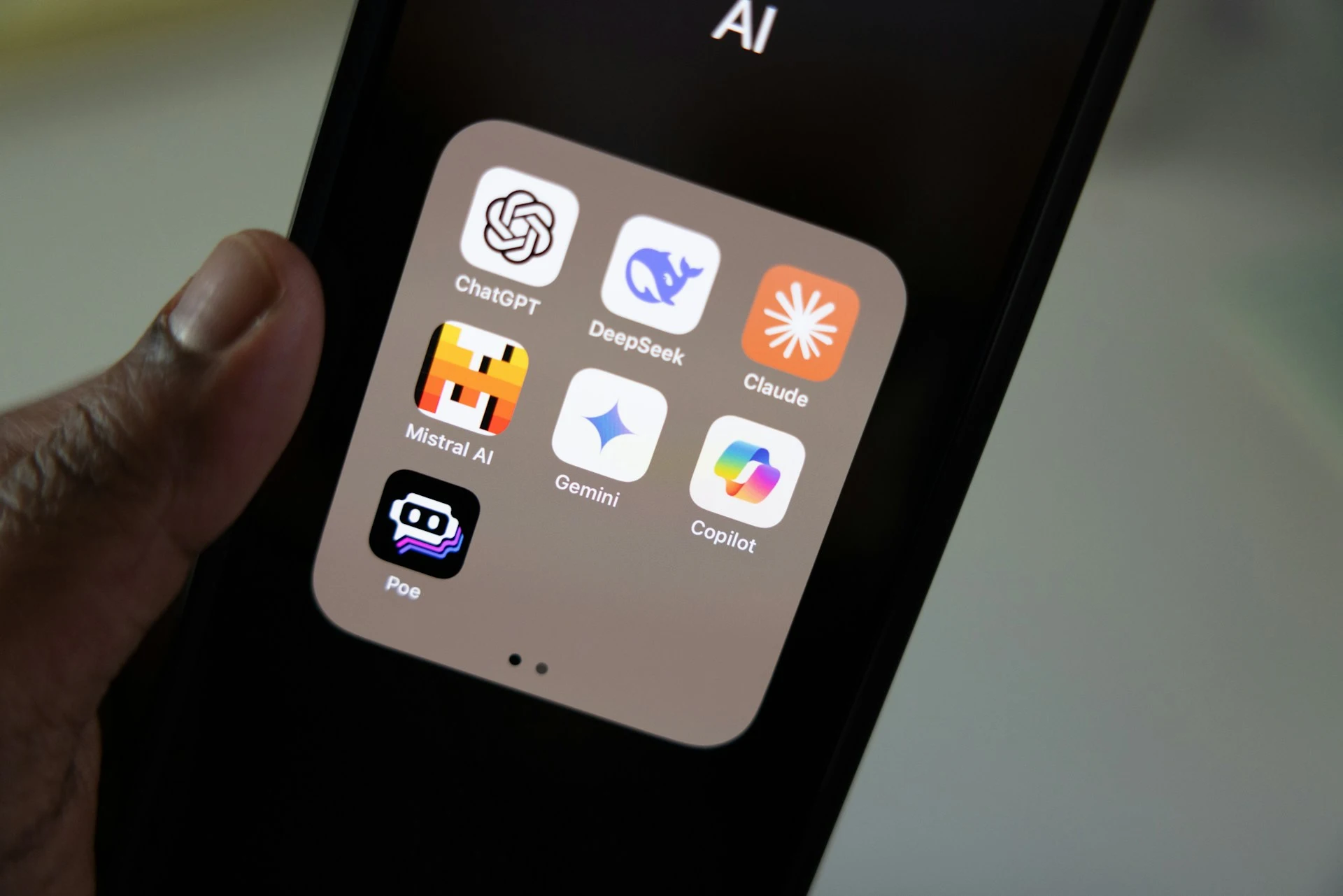
The AI market has developed rapidly in recent months. Every third company in Germany now uses AI technology — almost twice as many as a year ago. While ChatGPT dominated public perception for a long time, other AI models such as Anthropic's Claude, Google's Gemini, Meta's Llama, Mistral AI and specialised AI agents are now shaping the market.
Our overview shows you who is leading in which area, which AI tools are available for which applications and what really matters when making your choice. This is not a complete list of every existing AI tool — given the pace of development, that would simply be impossible. Instead, we offer guidance for your next step in working with AI technologies.
The big platforms: Who dominates the market?
Three names shape the AI market more than any others: OpenAI, Google and Amazon. They have created extensive ecosystems that have become the standard. Anyone using AI can barely avoid them.
OpenAI and the Microsoft ecosystem
OpenAI has practically defined the market for generative AI with ChatGPT and the GPT series. Integration with Microsoft products — Office, Teams, Azure — makes OpenAI technology the default option, often without a conscious choice.
The strength lies in versatility: a GPT model can answer customer enquiries, write code, translate texts and analyse data. The newer models, such as the GPT-5 generation (now GPT-5.6) and the reasoning variants (the o3/o4 series), show progress on complex problems and significantly improve natural language processing (NLP).
The downsides: intensive use leads to considerable costs. Companies also become dependent on a US provider, and data protection questions remain open when it comes to sensitive data.
Google Gemini and cloud integration
With Gemini and Google's cloud infrastructure, Google pursues a similar ecosystem approach. Integration with Workspace, Gmail and Google Docs makes it particularly interesting for companies that already operate within the Google universe. Gemini 3 Pro, the current flagship, offers an extended context window capable of processing very long documents.
The advantages: Google has decades of experience with search algorithms, extensive training data and strong integration across its own services. The critical point, however, is that the business model is built on advertising and data collection. For European SMEs with strict data protection requirements, this can be a relevant factor.
Amazon AWS as infrastructure backbone
Amazon dominates the infrastructure level with AWS. Many AI applications run on AWS servers, even when they do not come directly from Amazon. Amazon Bedrock provides access to various foundation models, and SageMaker offers tools for custom developments.
Scalability, reliability and a broad range of products are genuine advantages. From an SME perspective, however, there are also significant weaknesses: the high level of complexity requires substantial IT expertise, and cost structures can be opaque.
Language Models in everyday business: Who else counts besides ChatGPT?
While the major platforms score points through broad ecosystems, interesting alternatives have emerged in AI language models. OpenAI has shaped perception strongly in recent years — but in practice, other providers have now developed equivalent solutions.
Anthropic's Claude: the enterprise alternative
Anthropic's Claude — currently the Sonnet 5 and the more powerful Opus 4.8 models — has established itself as an alternative; more than that, Claude now dominates the enterprise sector. It is considered particularly strong for longer texts, complex analyses and safety-critical applications.
The company places a strong emphasis on "Constitutional AI" — AI with inherent safety and ethics principles built in. Claude has become the preferred tool of many developers for code generation. API integration enables flexible embeddings, and thoughtful tonality controls make Claude well suited for customer communication.
Open-Source models and digital sovereignty
Meta pursues an open-source strategy with Llama. The models can be downloaded, adapted and self-hosted — meaning maximum control and data security, but also higher demands on in-house IT capacity. For SMEs with their own IT teams and a need for digital sovereignty, it is an interesting option.
Mistral AI from France is positioning itself as a European alternative with a focus on efficiency and openness. The models are smaller and faster than those of the US competition, often with comparable quality. Mistral embodies the European approach — less Big Tech dominance, more control for users and GDPR-compliant from the ground up.
Enterprise-focused solutions
Cohere focuses on enterprise applications. Rather than consumer features, the emphasis is on document analysis, customer service and internal search. The AI applications are specifically optimised for corporate environments, with a focus on security and compliance. With Command A and Command A+, released under Apache 2.0, Cohere also delivered powerful enterprise models in 2026.
This first look shows that the range of available AI tools is broad and the options are diverse. That is precisely why dialogue with other decision makers is so valuable. We create that space at the data:unplugged festival, where you can exchange ideas with other SMEs about concrete practical examples. In masterclasses, tool applications are demonstrated and can be implemented and applied directly.
Specialised AI: where niche players dominate
Alongside universal language models, a second trend has emerged: highly specialised AI solutions. While the big platforms try to do everything, there are providers who lead in specific areas — often with better results than the generalists.
Translation: DeepL as the quality standard
DeepL has revolutionised the translation industry. Quality surpasses Google Translate, particularly for European languages. For internationally active SMEs, DeepL has become the standard — for standalone translations and for integration into content management systems, e-commerce platforms or customer service tools.
Image generation: variety for different requirements
In the era of AI image generators, Midjourney (now version 8) dominates artistically sophisticated visualisations. Its characteristic cinematic aesthetic often makes it the first choice for marketing visuals.
Stability AI's Stable Diffusion offers open-source flexibility with deep customisation. Adobe Firefly integrates AI image generation directly into Creative Suite. GPT Image (gpt-image-1) from OpenAI, integrated directly into ChatGPT, offers particularly intuitive operation through natural language input. The older DALL-E has since disappeared from ChatGPT.
Video and audio: the next generation of content
Runway, Synthesia and Descript are leading the way in AI video. Runway (now Gen-4) enables professional video editing with AI support. Synthesia creates videos with AI avatars — useful for training videos or multilingual content. Descript combines transcription, editing and AI-based audio enhancement in a single workflow.
Code assistants for developers
In the code area, GitHub Copilot dominates. Alternatives such as Tabnine, Windsurf (formerly Codeium) and Amazon Q Developer (formerly CodeWhisperer) offer similar functionality, often with better integration into specific development environments.
Business intelligence and data analysis
For data analysis and business intelligence, specialised tools such as ThoughtSpot, Tableau and Power BI use machine learning to identify patterns, flag anomalies and generate predictions.
European players: digital sovereignty in practice
Between the US-dominated platforms and the specialised niche players, a third important segment is emerging: European AI providers. The question "which AI tools are available from Europe?" touches on themes of data protection, independence from US technology and strategic autonomy.
Aleph Alpha: Germany's answer to OpenAI
Aleph Alpha from Germany develops language models with a focus on security, transparency and European values. The PhariaAI platform with the Pharia models works multilingually, is designed to be GDPR-compliant from the ground up and can be operated in your own data centre.
For public authorities, critical infrastructure and security-conscious companies, this is an important alternative — data stays in Europe and there is a degree of transparency about training sources. The challenge, however, is that the models are smaller than their US counterparts and come at a higher cost for comparable functionality.
Mistral AI: french efficiency
Mistral AI from France represents the European path in AI development. The company consistently follows an open-source approach, works transparently and develops efficient models that deliberately avoid vendor lock-in. The focus is on the interests of users, not on binding them to proprietary platforms. Mistral combines technical performance with European values such as data sovereignty and transparency.
The European AI ecosystem
Other relevant European initiatives include national AI labs in the Netherlands, Scandinavia and Switzerland. None have the market power of the US giants, but together they form an ecosystem that provides genuine alternatives.
According to a survey, the country of origin of the AI provider matters to 88 percent of German companies surveyed. 93 percent would prefer an AI solution from Germany. This shows that digital sovereignty is not a theoretical concept, but a concrete need — as our guests on the d:u podcast confirm time and again.
Industry-specific AI: solutions for concrete use cases
Alongside universal and specialised tools, a fourth segment is developing: industry-specific AI. These solutions are significantly better suited to particular applications than generalists.
Healthcare: accuracy and compliance
- Providers such as Tempus, PathAI and Ada Health use machine learning for diagnostic support, drug development and patient management.
- Specialised training and strict compliance requirements are critical here.
Manufacturing and industry 4.0
- Solutions such as Uptake and C3 AI offer predictive maintenance.
- Siemens with MindSphere and SAP with Leonardo integrate AI into established industrial platforms.
Financial sector: security and regulation
- Providers such as Kensho and DataRobot focus on fraud detection, risk assessment and automated advisory services.
- Strict compliance requirements shape deployment throughout.
Retail and e-commerce
- Recommendation engines and AI chatbots dominate.
- Shopify integrates AI directly, Salesforce provides CRM AI, Nosto focuses on personalisation.
Logistics and supply chain
- Tools from Blue Yonder and o9 Solutions optimise supply chains, forecast demand and plan routes.
From our experience working with decision makers, we know that companies achieve the best results when they combine industry-specific solutions with universal platforms — rather than relying on a single provider.
AI Agents and autonomous assistants: the trend changing everything
Across all AI application areas, one central trend is emerging: the shift from reactive AI chatbots to proactive AI agents that plan, coordinate and act independently.
What are AI Agents?
AI agents are advanced, AI-powered systems that go far beyond simple answers. They can automate complex tasks in everyday work and operate autonomously — organising meetings, managing email inboxes, controlling software applications or coordinating projects.
Examples of AI Agents
Examples include ChatGPT Agent (formerly Operator), Anthropic Computer Use and Google Project Mariner, which enable autonomous web and computer control and have become considerably more mature in 2026. These agents often use AI technologies with multimodal web access to process information from various sources, including PDF files and cloud-based systems.
Capabilities and benefits of AI Agents
They can independently make decisions, set priorities and optimise processes — which significantly accelerates the automation of routine tasks and relieves employees. AI agents act proactively, helping to make complex processes more efficient.
For further insights into specific application areas and how AI agents can be integrated into everyday working life, visit the data:unplugged festival.
What matters when choosing: decision criteria
With all these options — from large platforms to specialised tools to AI agents — the question is which AI tools are relevant for you. The answer is closely linked to your specific requirements.
Use case before technology: Selection should start from the concrete problem, not from the technology. Define the requirements first, then evaluate the right solution.
Data protection and compliance: For European SMEs, this is often a decisive criterion. Questions about data processing, GDPR compliance and server locations are relevant. Cloud-based US solutions often offer more functionality, but local alternatives may be preferable for compliance reasons.
Integration into existing systems: Even the most powerful AI remains ineffective without integration into the existing IT landscape. The availability of interfaces, APIs and compatibility with ERP or CRM systems are crucial.
Cost and scalability: Pay-per-use models allow low entry costs but can become expensive with intensive use. Fixed-cost models require higher upfront investment but often offer better long-term predictability.
Support and customisation options: Standard solutions can be implemented quickly but may not cover all specific requirements. Customisation options and quality of support both matter.
Future-proofing: Given the rapid pace of market development, active further development, regular updates and the financial stability of the provider should all be taken into account.
Lock-in risk: The degree of dependency on a single provider should be evaluated carefully. Open-source solutions or standardised interfaces reduce the risk of long-term commitment.
The AI market: consolidation and specialisation
Two parallel developments are shaping the market: consolidation among large platforms and increasing specialisation in niches.
The big three — OpenAI/Microsoft, Google and Amazon — are becoming more dominant through integration into established ecosystems and massive investment. At the same time, specialised providers are growing in their niches: DeepL for translations, Midjourney for image generation, sector solutions for healthcare, logistics and finance. This specialisation delivers better quality in defined application areas.
European players are competing for relevance — not due to technological weakness, but because of lower investment levels. For regulated industries and companies with high data protection requirements, however, they are becoming increasingly important. Open-source models such as Llama, Mistral and Stable Diffusion show that AI does not have to be proprietary. AI agents are evolving from concept to reality, and the vision of autonomous assistants is becoming increasingly practical.
Conclusion: From overview to strategy
The current AI market is defined by accelerating differentiation. Anthropic dominates the enterprise sector, reasoning models expand problem-solving capabilities, AI agents are becoming practical tools. At the same time, European providers offer privacy-compliant alternatives, while specialised tools often outperform generalists in their niches.
The strategic challenge is to identify the relevant options from this variety — based on concrete use cases and practical usability in everyday working life. Integration capability, specialisation and long-term viability count for more than marketing promises.
Find out how other SMEs have integrated AI technology into their processes at data:unplugged 2027 on April 13 & 14 in Münster, Germany. Companies from industry, retail, production and logistics share their implemented use cases — from finance to marketing, from IT to legal. On the SME Stage and four further stages, space is created for deep exchange grounded in real-world examples.
For effective AI implementation, it is crucial to bring all areas of your company along, develop their skills and prepare them positively for deployment. data:unplugged stands for broad and well-founded knowledge transfer — from which entire business teams benefit. Get a ticket for yourself and your core team now!
More blogs



for the d:u27!