
Sharpen AI decisions in exchange with peers
At d:u27 on 13 & 14 April 2027 in Münster, you meet decision makers in masterclasses, round tables and the new SME AI Village.

Why AI is a leadership matter
Artificial intelligence is no longer an IT project that can be delegated to a department. It changes business models, decision-making processes and the role of leaders themselves. AI touches almost every part of the company — from marketing and sales to production, HR and finance.
At the same time, regulatory pressure is rising. Since February 2025, Article 4 of the EU AI Act has obliged companies to ensure sufficient AI literacy among everyone who operates or uses AI systems. That applies in particular to leadership: anyone who is accountable for AI decisions has to understand AI.
The new role of the leader
The leadership role is shifting in several places at once. Decisions become more data-driven because AI-supported analysis can process large data volumes in real time. Routine tasks get automated — opening up space for strategic work. Collaboration with teams changes as employees adopt new tools and ways of working. Leaders increasingly become sparring partners for teams that use AI tools daily and bring back their own experiences.
Anyone who doesn't actively shape this shift gets carried along by it. That's the real reason AI in a leadership context isn't optional — it's a core responsibility.
The most common mistake: treating AI as a pure tech topic
In our conversations with executives from the Mittelstand, one pattern keeps showing up. AI gets reflexively delegated to IT or to a designated "AI lead". The result: pilot projects without a strategic frame — they work technically, but measurable business impact stays elusive.
The companies that successfully scale AI do it differently. They treat AI as a leadership topic. The management team understands the foundations, makes strategic decisions and sets clear guardrails. Implementation follows, not the other way around.
What leaders really need to understand about AI
Nobody expects a CEO to write machine-learning models themselves. But there is a basic understanding without which strategic AI decisions aren't possible.
AI foundations without the deep tech
Leaders should be able to place three terms confidently:
- Foundation models and Large Language Models (LLMs). The basis for generative AI tools like ChatGPT, Claude or Gemini. Models trained on vast data sets, broadly applicable.
- Machine learning. Methods where systems learn patterns from data and make predictions. The foundation for almost all data-driven AI applications.
- Agentic AI. AI systems that plan tasks autonomously, use tools and execute sub-steps. The next step beyond generative AI.
Covering these three concepts is enough to participate in strategy discussions. Deeper technical knowledge belongs with the specialists. Anyone looking for a compact entry point can start with a half-day course or an introductory workshop — what matters more than the format is the link back to your own leadership practice.
What AI can do — and what it can't
At least as important as the "what" is the "what for" and the "what not for". AI is strong at recognising patterns in large data sets, generating and transforming text, images or code, automating repetitive processes and producing forecasts based on historical data.
It is weak or unreliable at originally creative decisions, in situations without training data, and on questions that require contextual understanding beyond the training material. Knowing these limits prevents the most common mistaken expectations when making decisions with AI.
AI-supported is not AI-decided: the fine but crucial difference
A third point that is often underestimated: leaders need to understand the difference between AI-supported and AI-made decisions. AI can deliver analysis, evaluate options and offer recommendations. The responsibility for decisions stays with people — both legally and in practice.
This isn't an academic detail; it's a central question of leadership practice. Anyone who accepts AI recommendations without questioning them isn't shifting responsibility — they are hiding it.
Which decisions are pending in the company now
Once the foundations are in place, the strategic questions follow. Four of them belong on the C-level agenda over the next six to twelve months.
AI strategy: what do we actually want?
The most important decision is the strategic one. What role should AI play in the company? Is this about efficiency in individual processes, data-driven products, or a new business model? Without a clear answer, every AI project remains an island.
A solid AI strategy connects business strategy and AI deployment. It prioritises where AI is used first, which investments make sense, and which organisational changes go with them. Without that, AI deployment becomes a patchwork: lots of motion, little impact.
Use cases: where do we start?
The second decision is the prioritisation of concrete applications. Which AI use case will deliver measurable value in the next six months? Which case has high success probability and low implementation barriers?
Good prioritisation looks at three dimensions: business impact, technical feasibility and organisational readiness. Anyone who answers these questions properly avoids the classic pilot graveyard where AI projects quietly die.
Governance: guardrails belong on the C-level agenda
The third decision concerns the framework. How is AI deployed in the company, and how is it not? Who is allowed to use which tools? What data may flow into public AI systems? How are results documented and reviewed?
Without clear governance, AI deployment becomes a risk. With clear governance, it becomes a competitive advantage. The guardrails belong on the C-level agenda — not buried in an IT document.
AI literacy in the team: roles, not blanket coverage
The fourth decision is about people. Which AI competencies does which role need? How are employees enabled to use AI responsibly? Which training programmes make sense — for leaders themselves, and for their teams?
The EU AI Act has anchored this competency obligation in law. The topic can no longer be postponed. But it isn't only about compliance. It's about making the AI transformation in your own company actually executable.
One thing matters in particular: competencies differ by role. What a developer needs is fundamentally different from what someone in sales or controlling needs to know. Anyone who distributes AI training with a watering can wastes time and budget. Anyone who tailors it to roles builds real working capability.
From understanding to execution: which training really works
The market for AI training for executives has exploded. Every provider has a seminar, an online format, a course. But not everything on offer actually has impact.
What often doesn't work
Passive formats where executives sit through two days of presentations rarely produce lasting change. These courses transfer knowledge, but no working capability. And they don't answer the question that really keeps C-level up at night: how do I decide concretely in my situation?
Equally problematic: seminars that demonstrate AI tools but ignore the strategic frame. A prompt engineering course is useful, but it's no substitute for strategic understanding. And a single seminar without a connection back to real leadership practice usually fades within weeks.
What really works
Effective training for executives combines three elements:
- Solid foundations. Clearly structured content on technologies, applications and limits of AI — compact and decision-relevant.
- Exchange among peers. Conversations with other decision makers facing the same questions in their own organisations. Peer learning beats lectures every time.
- Concrete use cases from practice. Not abstract models, but real projects with real results — including the stumbling blocks.
What matters is the link back to practice. New competencies have to make their way back into the team. Leaders who involve their teams after a training and apply what they have learned together see the most lasting effects.
The second element in particular is the underrated lever. Leaders learn most from leaders who are one or two steps ahead — not from consultants who can build a slide deck. In conversations with peers, the real challenges of AI adoption become visible: resistance in the team, tight budgets, unclear prioritisation, uncertainty when choosing between competing use cases.
Formats that C-level actually need
Alongside classic executive programmes, formats have emerged that fit C-level needs particularly well: focused intensive days with peer exchange, round-table discussions with industry counterparts and practical formats where concrete use cases are shared.
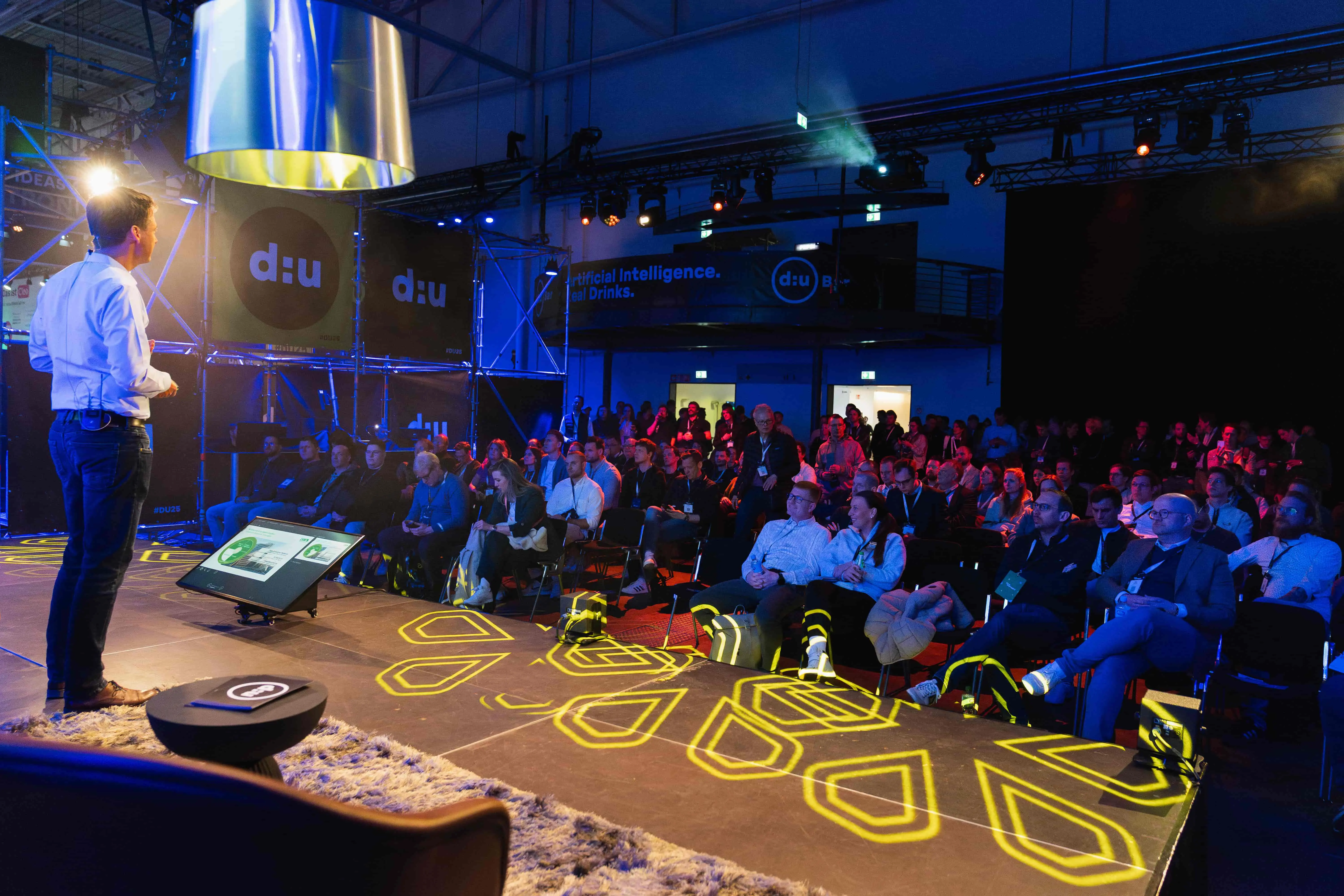
This is exactly the category the d:u27 Festival on 13 & 14 April 2027 in Münster sits in. Our festival is aimed at decision makers dealing with AI in their organisations: CIOs, CDOs, CTOs, CFOs, AI leads, data and analytics leads and enterprise architects. The content covers AI use cases, agentic AI, the path from data to AI and the scaling of AI in companies — on six stages, 350+ speakers, 80+ masterclasses and over 250 exhibitors with focus on real projects, with intense exchange.
For a broader overview, our articles on AI trade fairs and data events in Germany and the most important AI conferences in Europe 2026 cover formats for different needs, from specialist trade fairs to strategy summits.
Conclusion
AI for executives is a core responsibility, not an add-on
AI in everyday leadership isn't a technical question. It's a strategic responsibility that touches business model, organisation and leadership practice all at once. Leaders who have understood this invest in their own understanding, make clear decisions and choose training formats that actually work.
For the Mittelstand, that doesn't mean reinventing the leadership role. It means mastering the foundations, asking the right strategic questions, and actively seeking exchange with other decision makers. The challenges of AI transformation rarely get solved at the desk — they get solved in dialogue with leaders facing the same questions. Which AI trends for 2026 are particularly relevant in this context is something we covered separately.
The densest and most intense way to engage with all of this is at the d:u27 Festival on 13 & 14 April 2027 in Münster. Two days and six stages — with CIOs, CDOs and AI leads who don't sell theory but talk concretely about their real projects. Including the decisions they would make differently today. Get your ticket for d:u27 now.
FAQ
Does the AI literacy obligation also apply to senior management?
Yes. Since February 2025, Article 4 of the EU AI Act has obliged companies to ensure sufficient AI literacy among everyone who operates or uses AI systems. This applies to leadership in particular, because anyone accountable for AI decisions has to understand AI.
How much technical knowledge do I need about AI as a leader?
You don't need to write code. It's enough to place three terms confidently: foundation models or LLMs, machine learning and agentic AI. That lets you take part in strategy discussions, while deeper technical knowledge belongs with the specialists.
Can I delegate decisions to AI?
AI can deliver analysis, evaluate options and offer recommendations. The responsibility for decisions, however, stays with people, both legally and in practice. Anyone who accepts AI recommendations without questioning them isn't shifting responsibility, they are hiding it.
Is a prompt engineering course enough AI training for executives?
Such a course is useful, but it's no substitute for strategic understanding. Effective training combines solid foundations, exchange with other decision makers and concrete use cases from practice. It also matters that you bring what you have learned back into your own team.