
Which data & AI skills job ads actually ask for
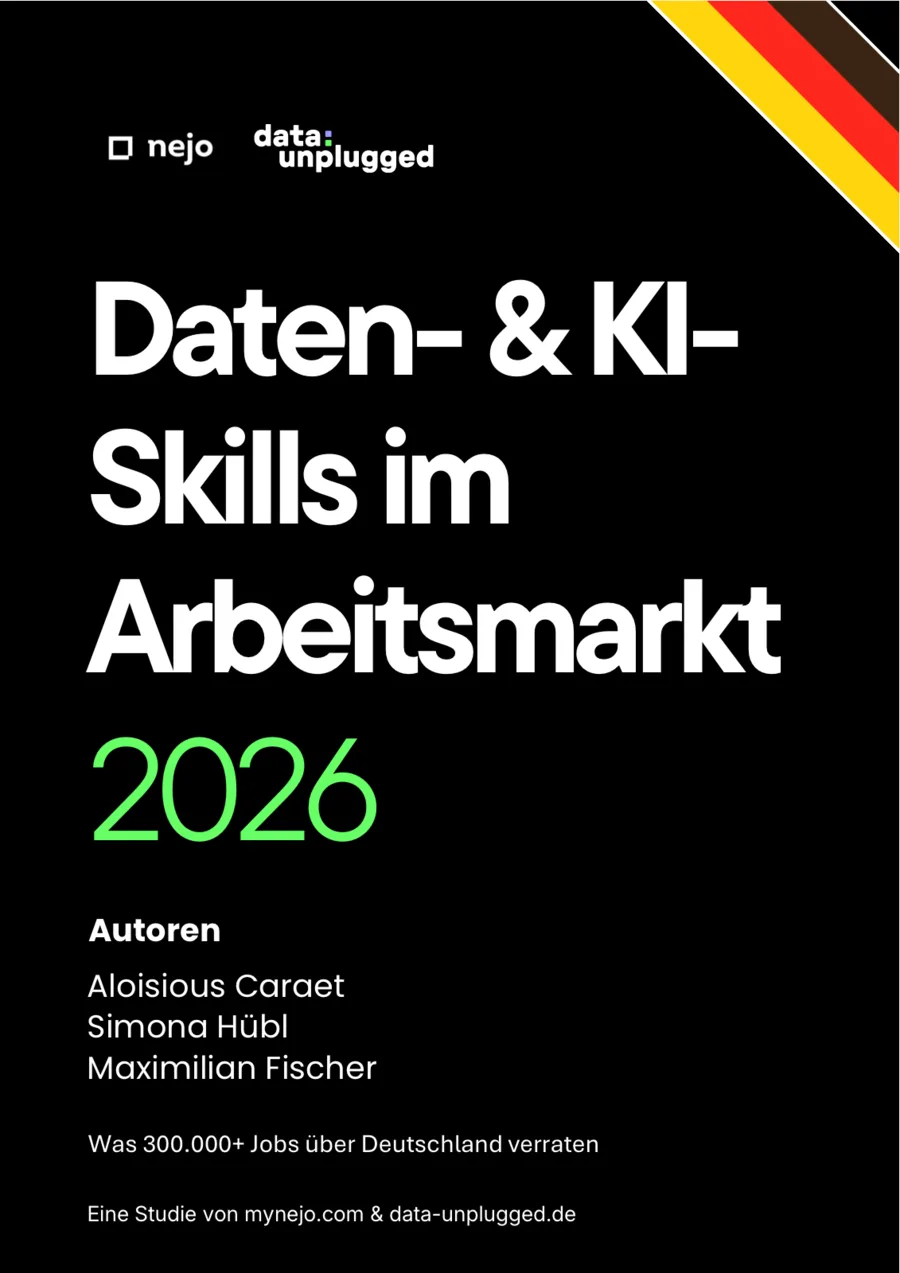
The DAISY Report 2026 analyses 324,445 job ads: 9 out of 10 roles with AI requirements don't carry an AI title.
Why this wave of change feels different
Previous waves of digitalisation largely affected routine work: production lines, bookkeeping, basic data entry. What's happening now is structurally different. Generative AI is increasingly reaching into non-routine cognitive tasks – exactly the kind of work that was previously considered safe: drafting copy, producing analyses, building presentations, delivering straightforward advisory services.
The WEF estimates that by 2030, around 22 per cent of current jobs will either be newly created or phased out as a result of structural change. What's striking is that the disruption is falling less on manual trades – skilled crafts, healthcare, education – and more on the core of traditional knowledge work.
For businesses in the German Mittelstand, this means the question is no longer whether AI will change how teams work, but how quickly and in which areas.
Which future roles are already taking shape?
New job profiles don't emerge overnight. Many of tomorrow's most in-demand roles are already visible today – some as established positions, others as growing areas of focus within existing careers. What matters less is the job title; what matters more is the underlying skill set.
AI specialists and machine learning experts
AI and machine learning professionals top the LinkedIn Trend Jobs 2026 growth rankings. These roles are currently concentrated in larger tech companies – but they're becoming increasingly relevant in the Mittelstand as AI systems need to be implemented, maintained and developed further.
Data analysts and data strategists
The ability to read data, interpret it and translate it into decisions is needed across virtually every sector. Data specialists rank among the WEF's top growth jobs – and not just in tech. From marketing to procurement to the boardroom, data literacy is becoming a core requirement for many leadership roles.
AI ethicists and governance specialists
The EU AI Act, GDPR and growing societal pressure for responsible AI deployment are creating demand for professionals who can assess technical systems within a legal and ethical framework. The WEF already recommends that companies introduce roles such as Chief AI Ethics Officer.
Cybersecurity professionals
More digital infrastructure means a larger attack surface. Regulatory pressure through NIS2 is adding to the urgency. IT security roles are among the most stable growth areas – and they combine technical expertise with organisational capabilities that are difficult to automate.
Green tech and sustainability roles
Energy managers, sustainability analysts, specialists in renewable energy – the Cornerstone Skills Economy Report 2026 explicitly names sustainability qualifications alongside AI competencies as key growth areas. The green transition is creating job profiles that barely existed a decade ago.
Software developers and IT professionals
IT roles and software development in particular remain in strong demand despite AI assistance – what's shifting is the nature of the work, not the need for it. Rather than writing standard code, developers are increasingly working as architects: defining what AI tools should generate, reviewing the output and integrating it into existing systems. STEM-based careers broadly retain their central importance. The skills shortage in IT is already tangible and is more likely to deepen than ease as demand for AI competency grows.
UX designers and digital creative roles
UX design is one of those disciplines that digitalisation brought into its own – and it continues to grow. UX designers shape how people interact with digital products, apps and platforms. As AI-driven interfaces become more widespread, good interface design becomes more important, not less. The same is true for other digital creative roles – social media managers, content creators, strategists – which are still sometimes dismissed as "soft" but are becoming increasingly data-driven and strategic.
Roles with stable long-term demand
Healthcare, education, skilled trades, social work, teaching – these fields are growing in response to demographic pressures, are difficult to automate and will remain stable areas of employment for the foreseeable future. In healthcare, for example, AI is significantly changing the work of doctors and nursing staff through better diagnostics, automated documentation and faster analysis of results – but it isn't replacing them. It creates space for what people do better: assess, decide, act.
How AI is changing day-to-day working life and what that means for teams is explored in our article Working with AI: from prompt to work system.
What future roles pay – and what that means for employers
Anyone hoping to attract talent for future-facing roles needs to understand what those candidates expect from the market. Salaries in high-demand areas such as AI, data analytics and cybersecurity sit well above the general average – supply is tight and demand is outpacing the rate at which training produces qualified candidates.
One finding from a study of the AI labour market is particularly telling: the job categories most affected by AI carry average salaries around 47 per cent higher than comparable less-exposed roles. AI is disproportionately touching well-educated, well-paid knowledge workers – and those same groups are using AI most actively, as a tool that amplifies their productivity.
For employers, the practical implication is clear: in the competition for qualified candidates in growth roles, a competitive salary alone is not enough. Development opportunities, a genuine culture of learning and modern working environments are becoming decisive factors in recruitment – particularly for Mittelstand businesses competing directly with larger corporates for the same talent.
For companies actively looking for data and AI specialists: d:u Match connects businesses from the DACH region with candidates who have specialised in exactly these roles – from data engineers to AI coordinators to governance professionals.
Apprenticeship or degree? What employers should know
The question of the right path into future-facing careers matters not just to young people starting out, but to employers looking to attract and develop new talent.
Practical vocational training is once again growing in popularity among younger generations – driven partly by AI and a softening job market in traditional office roles. Apprenticeship positions in IT-adjacent fields, skilled trades and healthcare are often filled faster than university programmes produce graduates.
At the same time, new dual study programmes and apprenticeship pathways are emerging that are tailored to future fields: IT systems integration, data science, digital marketing. It's worth for companies to actively engage with these routes – through partnerships with universities, through their own training programmes or by deliberately recruiting graduates from relevant degree courses.
How young people think about career choice is changing. School leavers and young adults planning their careers today are redefining security – not as staying in one profession, but as the ability to adapt. Companies that understand this and communicate it clearly will find it easier to attract talent. For the Mittelstand, this is a genuine opportunity: proximity, early responsibility and real development pathways are compelling arguments.
The skills that will really matter
Specific job profiles evolve; competencies shift more slowly but more durably. What the Future of Jobs Report 2025 shows clearly is that analytical thinking is the most important core competency for the years ahead – seven in ten companies rate it as essential. Close behind are resilience, adaptability, creative thinking and leadership capability.
None of this is new, but the urgency is growing because AI is taking over exactly those tasks that previously required no deep competency: research, first drafts, basic reporting. What remains is judgement, decisions, relationships and accountability.
Alongside this, a new foundational competency is emerging: AI literacy – a basic understanding of how AI systems work, what they can do and where their limits lie – is becoming a cross-cutting skill for virtually every profession. Not as a specialism, but as a baseline.
How AI tools can be meaningfully integrated into working practice – and what remains irreplaceable on the human side – is explored in our article What AI can't do – and why that's an opportunity.
Building AI literacy across all levels is a challenge that most companies are still in the early stages of tackling. At our events, Mittelstand companies share how they've been preparing their teams for the transition in concrete terms – from first pilot projects to company-wide rollouts.
What this means for businesses – and what to do now
The WEF Report highlights a sobering figure: 59 per cent of the global workforce will need retraining by 2030. 85 per cent of the companies surveyed plan to prioritise upskilling. The gap between intention and action remains large.
For companies that want to act now, three levers stand out.
Skills inventories, not job descriptions. Knowing what capabilities already exist within a team makes it possible to develop them deliberately – rather than waiting until gaps become painful. Many Mittelstand companies underestimate the potential already present when it's actively supported.
Training as a strategic investment. According to research, the skills required for a given job have changed by 25 per cent since 2015 – and could shift by 65 per cent by 2030. Modular formats that build AI competency, data understanding or digital methods are more effective than broad training programmes.
Integrating new roles early. Data analyst, AI coordinator, sustainability manager – these aren't roles that only large corporations need. Mittelstand companies that build or recruit these competencies early will gain an advantage in a market where the skills shortage in these areas is particularly acute. Those who don't want to start from scratch will find a direct entry point at d:u Match – a specialist job platform for the German-speaking data and AI market.
An overview of AI trade fairs and data events in Germany is a good starting point for companies looking to prepare their teams for change.
Conclusion
change demands concrete decisions
Jobs of the future aren't emerging at some distant point – they're emerging now. Leaders don't need to know every technical detail, but they should understand where work is heading: away from routine, towards judgement; away from information management, towards decision-making; away from rigid job profiles, towards flexible skills frameworks.
The Mittelstand has structural advantages here. Flat hierarchies allow for fast decisions on training and development. Close team structures enable targeted skills development. And the direct connection between leaders and their teams makes it easier to shape the transition together.
Companies looking for talent in data and AI roles – or professionals who want to position themselves in this space – will find the right entry point at d:u Match, with talent profiles and job listings from the DACH region tailored to this market.
The shift becomes most tangible in conversation with companies already navigating it: at the d:u27 Festival on 13 & 14 April 2027 in Münster. Six stages, 350+ speakers, 80+ masterclasses and over 250 exhibitors, covering AI use cases in the enterprise and scaling AI — with decision-makers and AI leads who've already guided their teams through the rough patches. Get your ticket for d:u27 now!
FAQ
Which kinds of work is generative AI changing most?
Generative AI is increasingly reaching into non-routine cognitive tasks: drafting copy, producing analyses, building presentations or delivering straightforward advisory services. Manual fields such as skilled trades, healthcare and education are less affected. The disruption falls mainly on the core of traditional knowledge work.
Will AI make software developers obsolete?
No, IT roles and software development in particular remain in strong demand despite AI assistance. What shifts is the nature of the work, not the need for it: developers define what AI tools should generate, review the output and integrate it into existing systems.
Is a good salary enough to attract talent for data and AI roles?
A competitive salary alone is not enough. Development opportunities, a genuine culture of learning and modern working environments are becoming decisive factors in recruitment. This applies especially to the Mittelstand, which competes directly with larger corporates for the same talent.
What does AI literacy mean and who needs it?
AI literacy is a basic understanding of how AI systems work, what they can do and where their limits lie. It is becoming a cross-cutting skill for virtually every profession, not as a specialism but as a baseline.
How many workers will need retraining by 2030?
According to the WEF Report, 59 per cent of the global workforce will need retraining by 2030. 85 per cent of the companies surveyed plan to prioritise upskilling, yet the gap between intention and action remains large. Modular formats on AI competency, data understanding or digital methods are considered more effective than broad training programmes.