
Is the AI bubble about to burst? Philipp Klöckner on the hype and the reality of AI

Few questions are being asked as often right now as this one: is the AI bubble bursting? The headlines run from "biggest boom in history" to "inevitable crash". For decision makers at mid-sized companies that is confusing and paralysing, especially when it turns into the question of whether getting started with artificial intelligence is still worth it at all.
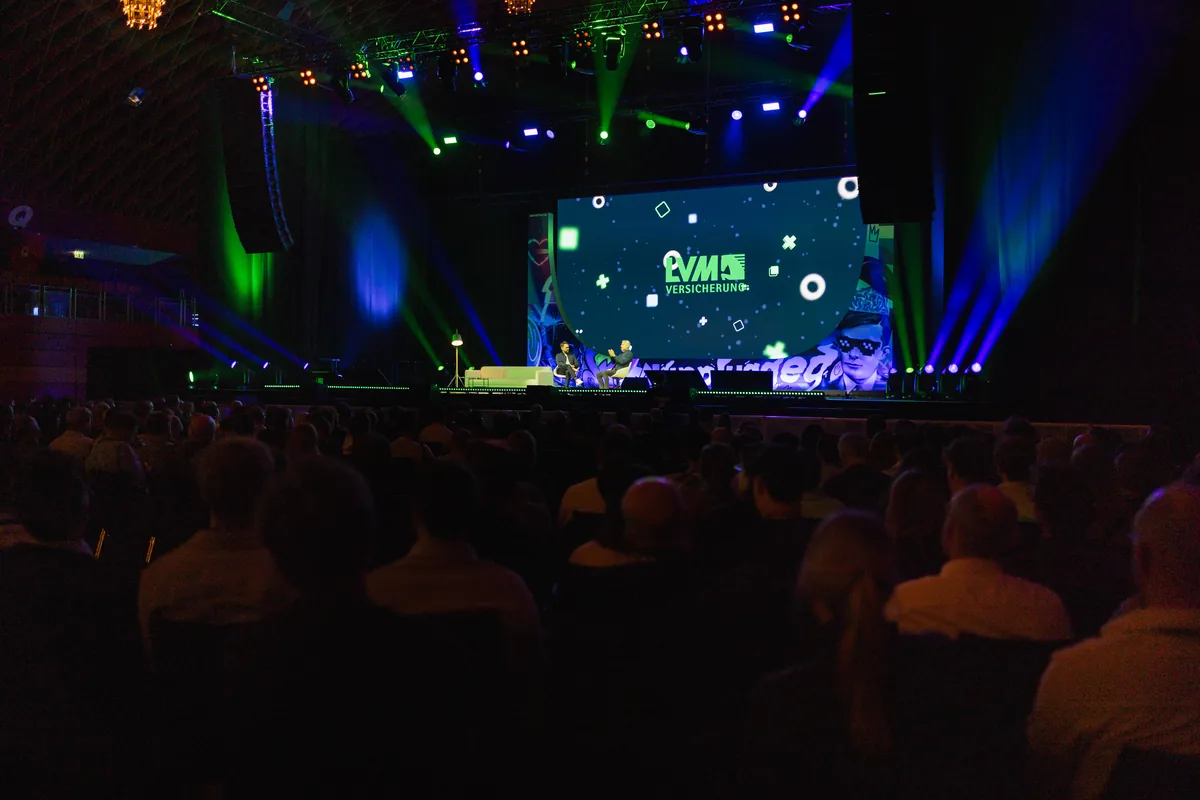
At the data:unplugged festival, tech analyst Philipp "Pip" Klöckner dissected exactly that question in his keynote "Beyond the AI Hype". His answer is refreshingly level-headed. It is not about a simple yes or no, but about separating two things that the bubble debate constantly conflates: the financial hype and the actual technological development. That is the distinction we want to unpack here – with substance rather than panic.
Why everyone is talking about an AI bubble
The concern is not plucked out of thin air. On the investment side, artificial intelligence has reached a scale that dwarfs any historical comparison. According to industry estimates, the big cloud groups are investing around 700 billion US dollars in AI infrastructure in 2026. That is almost six times the 2022 level – a boom whose scale gives even experienced investors pause.
Klöckner puts the number in perspective. It works out at roughly two billion dollars a day and around two per cent of total US economic output. By way of comparison, he cites the three largest projects in US history: the Manhattan Project, the Marshall Plan and the Apollo programme cost less in today's dollars, combined, than big tech puts into data centres in a single year. The entire EU budget is smaller than that annual investment.
There are also structural features reminiscent of the dotcom bubble. A considerable share of the money simply circulates. Chip manufacturers such as Nvidia invest billions in AI start-ups, which spend the money straight back on their chips. This circular financing drives valuations to dizzying heights. OpenAI, for instance, is valued at around 840 billion dollars after just eleven years in business. Traditional corporations took decades to get there.
The real risk lies in the gap between spending and revenue. For some players, spending on new data centres has long since outstripped their revenue, and a large part of operating cash flow goes into the build-out. OpenAI is targeting 284 billion dollars in revenue by 2030, with around half of that expected to come from end customers. Yet only about five per cent of ChatGPT users currently pay. The difference would have to come from advertising, something OpenAI had long categorically ruled out.
Because traditional investors and venture capitalists can no longer keep pace with sums like these, the big AI firms are pushing towards public markets. Klöckner points to an uncomfortable consequence. Through index funds and savings plans, part of these bets sooner or later lands in the portfolios of perfectly ordinary investors, often without them ever having deliberately bought AI stocks.
These are real warning signs, and you can feel the fear of a bursting bubble in the equity markets. Look only at those risks and you quickly conclude: this cannot end well.
The crucial distinction: investment hype is not technological progress
This is exactly where Klöckner's core point sits. He draws a clean line between the financial hype and the actual technological development – two things that work in entirely different ways.
The "trough of disillusionment" is a phase, not an ending
To put this in context, he uses the familiar hype cycle, in which new technologies first raise inflated expectations, then fall into a "trough of disillusionment", and only then start delivering real productive value. His point is that we are probably close to the bottom of that trough, but that the trough is a phase and not an ending. Disillusionment is usually followed by the phase in which the technology creates real value at scale.
The models really are getting better
Because while valuations run hot on the money side, the models themselves keep developing without interruption. Klöckner illustrates this with concrete examples. Take a notoriously hard knowledge test. At the end of 2024, the best model could barely answer a single question on it. Today, leading models get more than half of them right. And the span of time an AI can work independently on a task has risen from a few minutes to several hours.
This progress is driven by hardware that grows more capable each year, by reinforcement learning and by ever larger, cleaner datasets. The real performance curve points steeply upwards, regardless of what happens on the stock market. A possible market correction would therefore hit the financing, not the technology.
Why the dotcom comparison falls short
The comparison with the year 2000 also falls short in one crucial respect. Today's tech giants are highly profitable and generate enormous cash flows, unlike many dotcom firms that never made money. Admittedly, nearly all of their operating cash flow now goes into AI investment, so many will soon be net borrowers. A selective correction of inflated valuations is therefore a real risk.
But the underlying demand is real. OpenAI and Anthropic have beaten their revenue forecasts every time so far and now sit at roughly 25 and 19 billion dollars in annual revenue respectively. No company has ever built revenue at that volume so quickly.
A look at economic history supports the point. Railways, electricity, the fibre networks of the late 1990s – almost every foundational technology went through a phase of euphoric over-investment followed by a shake-out. And the infrastructure stayed regardless, fundamentally changing the economy. For practical purposes it is therefore largely irrelevant if or when the markets crack. Artificial intelligence remains a foundational technology.
Another signal points to substance. While private users often abandon AI tools after a few months, loyalty among business customers is rising markedly. In 2022 only about half of B2B customers were still there after a year; today it is over 85 per cent. Initial churn is increasingly turning into growing retention, a pattern typical of sustainable rather than speculative demand.
What this means for mid-sized companies
For SMEs the genuinely important insight is a reassuring one. The bubble debate plays out at the level of billion-dollar valuations and share prices, not at the level of your specific use cases. Deploy AI sensibly today and you do not lose that benefit simply because prices correct on the stock market.
On the contrary, Klöckner shows that the actual problem is not the hype but the implementation. Three figures from his keynote make that clear:
- More than half of AI projects never get beyond the pilot phase.
- Even within IT, around 90 per cent of projects do not scale.
- Four out of five employees have no access to AI at all.
That is precisely why productivity is not rising in many companies – not because the technology is too weak, but because it never reaches people at scale. Three levers matter most for mid-sized companies.
Your own use cases
Instead of "what is the next hot AI tool?", the question that counts is "which of our tasks takes the most time, and could AI help?" The starting point is always the specific use case, not the technology. How to get from the first prompt to a real working system is something we cover in our article on working with AI.
Access for employees
If four out of five employees have no AI access, this is the single biggest unused lever there is. Giving official, secure access to everyone who could use it will get more out of your existing technology, straight away, than any new model would. And access on its own is only half the job: what people can do with it depends on AI training for employees. This race is won not on the stock market but in what you actually implement in your own organisation.
Sovereignty over your own data
Klöckner is clear about where the real moat lies: not in the best model, but in data, hardware and distribution. Large platforms such as Google dominate all three. For mid-sized companies one clear lesson follows. Your own data is the one asset that is genuinely yours. Organise it and use it on your own terms and you become less dependent on the ups and downs of the market.
Open-source models increasingly help here, reaching the performance of the best commercial systems with only a short lag and in some cases running locally. Our article on open-source AI models gives an overview. That said, many of the strongest open models now come from China, which makes the question of data sovereignty and digital independence all the more pressing. If you would rather work with European providers, you will find the relevant options in our overview of European AI.
How other mid-sized companies use exactly these levers, beyond hype and panic, is something you can pick up first-hand at d:u27 on 13 and 14 April in Münster.
Conclusion: "will the AI bubble burst" is the wrong question
It is an understandable question, but a misleading one. It directs attention towards share prices and timing, and away from what actually matters. As Klöckner's keynote shows, the crucial distinction is between a possible investment hype and a real technological development that remains largely untouched by it.
For you as a mid-sized company, the better question is therefore not "when does it burst?" but "what remains, and what do we do with it?" Pursue your own use cases, give your teams access and use your data on your own terms, and you are prepared for both scenarios: a market correction just as much as the productive phase that follows every trough of disillusionment. That stance protects against both expensive risks – running blindly with the hype, and freezing in fear of the crash.
The full "Beyond the AI Hype" keynote and further sessions are available in the d:u Education library. And if you want to experience the debate live and first-hand, d:u27 on 13 and 14 April 2027 in Münster is the place. It brings together around 17,000 participants across six stages, with over 350 speakers, for an honest look at what sits behind the hype. Secure your tickets for d:u27 now!
More blogs



for the d:u27!