
AI training for employees: how SMEs build AI literacy in the team

Most companies have had AI tools in place for a while now. What is missing is AI training for employees – the knowledge to use those tools properly. In 2026, that gap is becoming the decisive bottleneck and the biggest opportunity for mid-sized companies.
The figures are unambiguous. According to the Bitkom study on artificial intelligence, a lack of AI know-how ranks among the biggest obstacles to AI adoption at 53 per cent – level with legal uncertainty and ahead of a shortage of staff. And the TÜV professional development study 2026 shows how far behind companies are: while 56 per cent use generative AI in day-to-day work, only 27 per cent have trained their employees to do so.
That gap between usage and qualification is the real risk. Where people deploy AI without guidance, you get mistakes, data protection problems and frustration, while the productivity gain you were after never materialises. This article looks at why capability is the biggest lever, what the new training obligation means and what good AI training actually looks like.
Why skill, not technology, is the biggest lever
It is a widespread misconception that adopting artificial intelligence is primarily a question of picking the right tools. The technology has been here for some time and is accessible to everyone. What is missing is the ability to deploy it so that real value emerges.
You can see it in everyday work. A team tries ChatGPT, drafts a few pieces of copy, is moderately impressed and quietly lets it go. Not because the tool is poor, but because nobody has learned to use it beyond the single prompt. This is exactly where companies that genuinely get more productive with AI diverge from those still stuck at the experimenting stage.
Capability is therefore the multiplier that determines the entire return on an AI investment. Without it, even the best tool remains an expensive toy. How teams make the jump from occasional prompting to a real working system is something we describe in detail in our article on working with AI. It all rests on one thing: people understanding the technology.
AI training is both an obligation and an opportunity
Since February 2025, AI literacy has been more than a good idea – it is a legal requirement. Article 4 of the EU AI Act requires companies deploying artificial intelligence to ensure their staff have a sufficient level of AI literacy. That means not only technical know-how but also an understanding of legal and ethical questions. What this means alongside the GDPR is something we set out in our article on AI, data protection and the GDPR.
The obligation matters, but treating it as the only motivation would be a mistake. Anyone treating training as a compliance tick-box is throwing away the real prize, because AI literacy feeds directly into productivity, staff retention and competitiveness.
The discrepancy is striking. According to the TÜV study, 87 per cent of companies consider training important, yet only a minority implement it strategically. Close that gap first and you gain a genuine head start, particularly in the mid-market, where the shortfall is largest.
The ground to make up is not evenly spread. While 49 per cent of large companies train their employees, the figure is 32 per cent at medium-sized companies and just 21 per cent at small ones. Across all sizes, 43 per cent of companies offer no AI training at all so far, according to Bitkom. For SMEs that is not a reason to give up but an opening, because nowhere is the gap to the big players easier to close than on skills.
What good AI training for employees looks like
Effective AI training is not a case of giving everyone the same content. It is targeted, practical and designed to last. Three principles work well in practice.
Role-based rather than one-size-fits-all
Not everyone in the company needs the same knowledge. A manager needs to judge where AI fits strategically and make decisions on it, while a marketing specialist needs hands-on, practical AI skills. The biggest gap here is not among data scientists but among specialists who want to apply AI within their existing field – in marketing, HR, sales or procurement.
A tiered approach by role therefore makes sense: strategic foundations for executives, hands-on training for business functions, deeper courses for anyone supporting AI projects technically. Which foundations decision makers specifically need is covered in our article on AI for executives.
Combining internal and external
External courses deliver structured knowledge – online learning, training sessions, certificate programmes, and the offerings of Germany's chambers of commerce (IHK). They are the fastest route to solid foundations and can be built flexibly into the working week as remote or online training. That is why we make the content from every d:u26 stage available to everyone. In the d:u Education library, your team will find in-depth expert knowledge on demand plus an overview of the developments currently shaping the field.
Internal knowledge transfer matters just as much. Teams that regularly compare notes on AI tools, and talk about what works and what does not, build a feel for real value far faster. That everyday practice is often worth more than any individual seminar. The combination of the two is the key.
When choosing external providers, it pays to look at quality rather than simply collecting certificates. Three questions help. Is the content practical and transferable to your own industry? Is it AZAV-certified and therefore eligible for funding through the German education voucher (Bildungsgutschein)? And does it cover legal and ethical aspects alongside the technology, as the AI Act requires? An IHK certificate or a certificate programme from a university carries extra weight and formal recognition.
Continuous rather than one-off
A single training session is not enough. AI technologies are developing at a pace that makes any one-off course age quickly. What is state of the art today may be superseded in six months. AI upskilling is therefore not a project with an end date but a continuous process that belongs inside the company culture. Fixed routines – a short monthly catch-up, or internal sessions where new tools and experiences get shared – keep knowledge current and turn training into a habit rather than a one-time obligation.
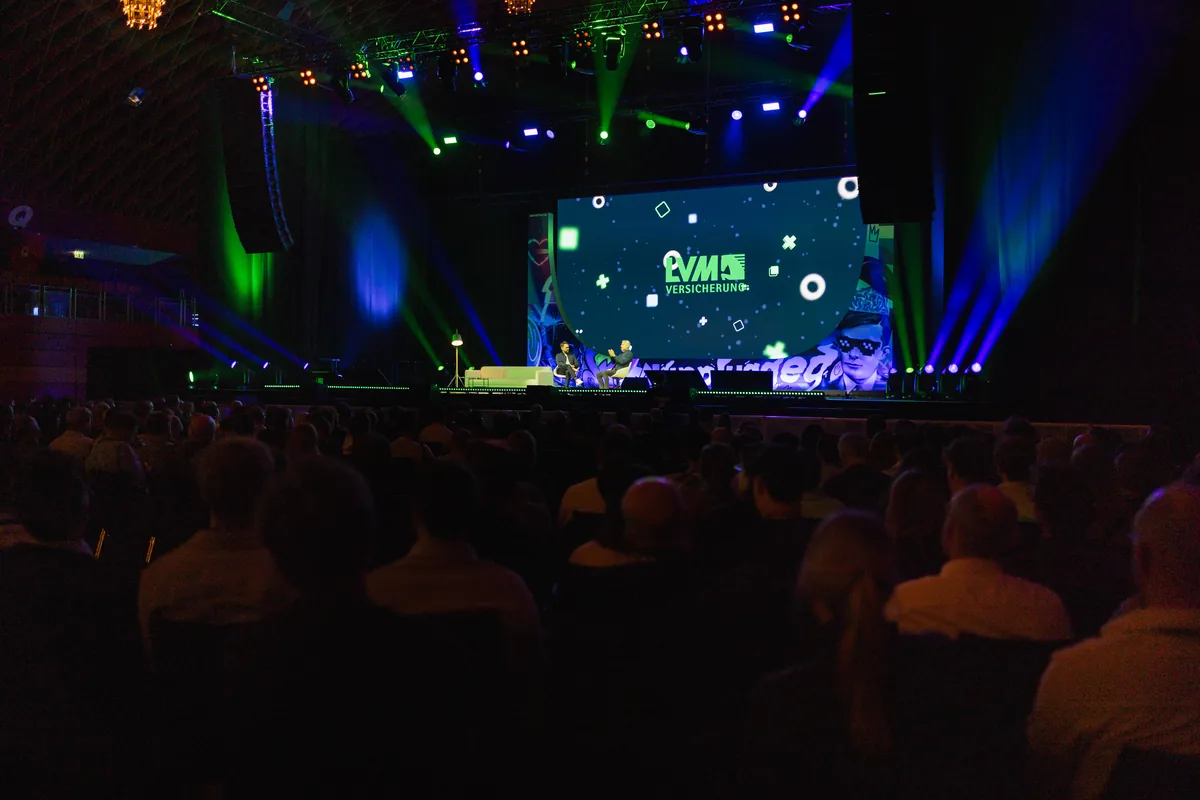
Going to trade fairs and conferences with a clear plan is a good complement to this ongoing skills-building. At d:u27 in Münster, Germany's largest festival for data and AI, teams dive into their own subject areas and deepen their knowledge in masterclasses tailored to their particular role. Pick the right sessions in advance and you often cover more relevant ground than a general-purpose online academy would. The SME Stage also shows how other mid-sized companies are tackling this in practice.
What AI training should teach
Good training does not consist of tool tutorials that will be out of date tomorrow – not least because the market of available AI tools keeps shifting. It builds understanding that lasts. Four areas belong in every programme:
- Foundational understanding: what artificial intelligence can do, where its limits lie and how generative AI and machine learning work at their core.
- Practical application: prompting, choosing the right tool for the right task and integrating it into existing workflows.
- Staying on the right side of the law: handling data protection, the GDPR and the EU AI Act training obligation, so that productivity does not turn into compliance risk.
- Critical judgement: reviewing output, spotting hallucinations and keeping responsibility for decisions with people.
Cover those four areas and you turn employees into confident users who can judge where AI fits and use it sensibly – not just button-pushers.
How to get started
The path to an AI-literate organisation does not have to begin with a large transformation programme. A pragmatic start is more effective than a perfect master plan. This sequence works well:
- Assess the current level: who uses which tools today, where is knowledge missing, which roles need what?
- Start with a pilot group that uses AI systematically over a few weeks and documents its experience.
- Use available funding: through Germany's Qualifizierungschancengesetz, the Federal Employment Agency pays wage subsidies for staff on training, and AZAV-certified courses are eligible for up to 100 per cent funding via the education voucher.
- Share knowledge across the company so that individual learning turns into shared capability.
The funding angle in particular gets overlooked. For many mid-sized companies, a considerable share of training costs can be covered through existing programmes. The investment is smaller than most people assume.
In the d:u Education library you will find practical masterclasses and recordings from experts who have worked through exactly these topics, from AI fundamentals to concrete fields of application.
Conclusion: capability is the foundation
AI adoption is decided not by the technology but by the people using it. The 53 per cent who name a lack of skills as the biggest obstacle are, in the same breath, naming the biggest lever. Enable your team and you get several times more out of the same tools, while meeting the requirements of the AI Act along the way.
The best moment to start is now – not with a perfect plan but with a first, manageable step. Those first experiences are what build the confidence for everything that follows.
AI literacy makes most sense when you see it up close, talking to companies already doing it. d:u27 on 13 and 14 April 2027 in Münster brings together around 17,000 participants across six stages, with more than 80 masterclasses and over 350 speakers, packed with practical knowledge on AI literacy, application and transformation. Secure your tickets for d:u27 now!
More blogs



for the d:u27!