
Vibe coding 2026: the tools that make writing code optional

In February 2025, AI researcher Andrej Karpathy posted a single sentence on X that would change the world of software development: "There's a new kind of coding I call vibe coding, where you fully give in to the vibes, embrace exponentials, and forget that the code even exists." What he shared as an offhand thought became an industry term within months – and went on to win Word of the Year 2025 from the Collins Dictionary. Today, non-technical staff in companies are writing entire applications simply by describing what they want to an AI in plain language. Just how far adoption has come is clear from the Stack Overflow Developer Survey 2025: 84 per cent of developers surveyed worldwide use or plan to use AI tools in their workflow – up from 76 per cent the year before. Building software has never been this accessible – or this contested.
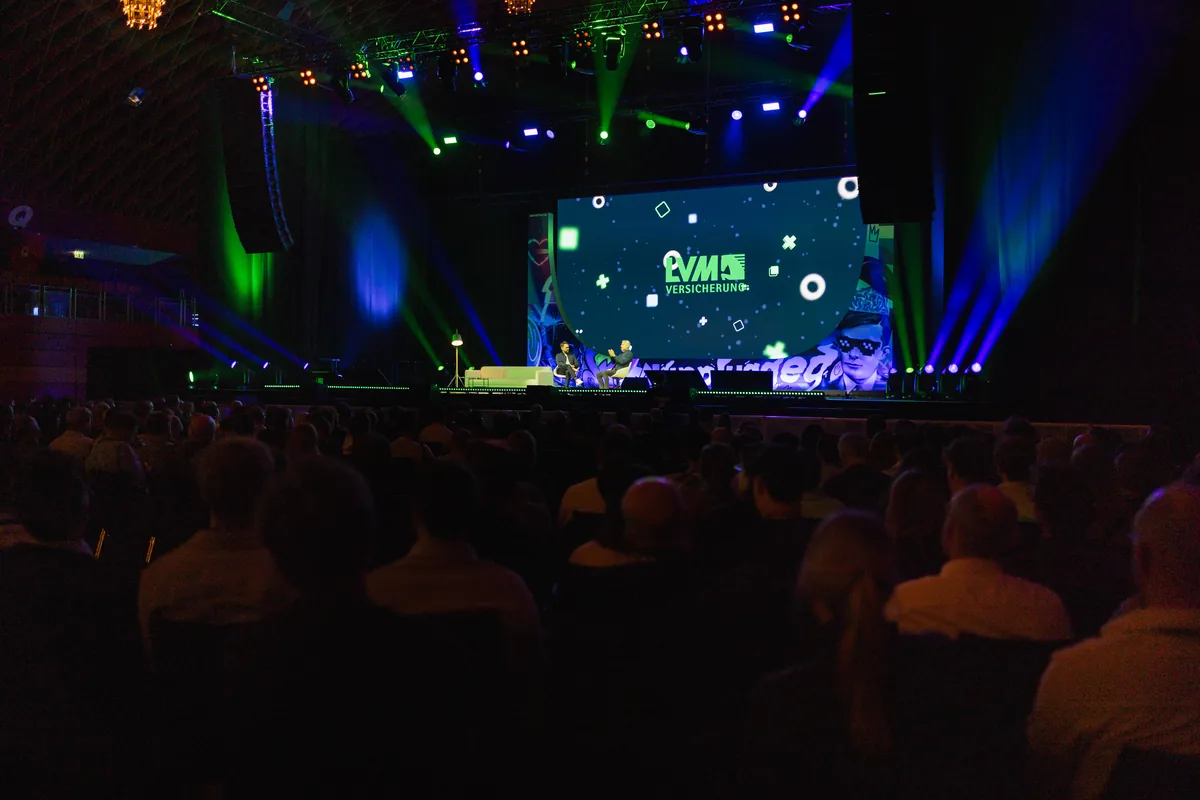
So what does vibe coding actually mean in practice? Where does it create real value for businesses, and where are its limits? At d:u26, Johannes Kliesch, Managing Director of SNOCKS, and Calvin Blick, Managing Director of HeroSoftware, answered exactly these questions – with refreshingly honest insights from their own working lives. This article pulls together the key takeaways, sets them in a wider context and shows when vibe coding pays off for SMEs and when it doesn't. You can watch the full session from both founders – along with every talk from d:u26 – on demand in the d:u Education media library.
What is vibe coding?
Vibe coding is a form of software development in which a user describes to an AI, in natural language, what an application should do. From a single prompt, the language model generates all the code, without the person writing the prompt understanding or writing every line themselves. Karpathy put it pointedly: you give in to the process, trust the models and forget that the code even exists.
What makes this possible are the advances in large language models. Modern models such as Claude Opus, GPT-5 and Gemini can now produce several hundred lines of working code from a single natural-language prompt. These LLMs are the technical foundation without which the method simply wouldn't work.
This is more than a marketing phrase. It describes a genuine break with the way software has been built until now. Classic development starts with a technical specification, followed by architecture decisions, code, tests and reviews. Vibe coding starts with an idea – "I need a reservation system for the café" – and ends, in the best case, with a working application. Whatever happens in between is handled by the AI.
One distinction matters: vibe coding is not the same as AI-assisted programming with conventional AI tools. Anyone using GitHub Copilot or Cursor and reviewing every line of AI-generated code is doing AI-assisted programming. Anyone who describes a tool to an AI and adopts the result without checking the generated code is vibe coding. The difference lies in control. For more on the tools available, see ouroverview of AI coding tools 2026.
The most important vibe coding tools
The market consolidated quickly across 2025 and 2026. Four providers stand out today.
Lovable
Lovable is now considered one of the highest-reach platforms in the vibe coding market. That's down not to superior technology, but to usability. SNOCKS Managing Director Johannes Kliesch describes it aptly: "Lovable is a bit like the iPhone. It looks the coolest, it's the most fun and interactive to work with." For a company of 150 people like SNOCKS, that's exactly what counts – the tools only get used if the work is enjoyable. SNOCKS has so far spent around €40,000 on Lovable credits and delivered all of its internal web projects with it.
Replit Agent
Replit targets a more technical audience: multiple parallel agents, more customisation, more configuration options. For solo founders and one-person teams it's often the more capable choice, but for larger teams it's frequently too complex. Kliesch recommends it for exactly that audience: "If you're a one-man band or a one-woman band, then Replit is a bit like Android."
Bolt and v0
Bolt turns a chat input into complete web apps, including backend and database. Vercel's v0 specialises in React components and frontend code. Both are especially suited to UI prototypes and rapid prototyping before a larger investment.
Base44
Base44 gained attention across 2025 and 2026 as a serious contender, particularly for more complex applications with database connections.
Where vibe coding actually saves money: real examples from SNOCKS
What separates hype from practice? Concrete numbers. In its d:u26 session, SNOCKS broke down exactly where vibe coding saves measurable money.
A reservation system for the café
SNOCKS runs its own café in Mannheim, turning over around a million euros a year. For the reservation system, the company was paying an external provider €300 to €400 a month. Within a week, the internal team rebuilt the entire application through vibe coding. One-off cost in Lovable credits: roughly €500 to €1,000. Ongoing costs afterwards: close to zero. Payback is a matter of months.
An internal form tool instead of Typeform
Typeform is a popular standard service for online forms. SNOCKS was spending up to €1,000 a month on it. The rebuilt Lovable version is going live now, and the ongoing effort is negligible.
Websites and landing pages
For simple B2B sites and agency websites without complex functionality, Kliesch sees no need for traditional web agencies any more: "Anyone still paying an agency for that today – completely unnecessary." Lovable and similar tools can read a URL as a template and rebuild designs in a company's own brand colours. For pure prototyping ahead of a larger investment, the approach is especially worthwhile, because ideas can be made testable in a matter of hours.
The pattern is clear: wherever an application is at heart a nicer database with simple logic – reservations, forms, basic dashboards, websites – vibe coding creates measurable value. Ideas from the business units themselves can also be translated straight into working applications.
Where vibe coding clearly hits its limits
Calvin Blick of HeroSoftware was just as honest about where the approach doesn't work. In his d:u26 talk, he spoke openly about a project that went wrong inside his own company.
The CRM experiment
"I just vibe-coded a CRM for us," Blick reported. "I thought, hey, ultra smart, HubSpot will be bankrupt in a few years anyway, let's just do it ourselves." The sober verdict: 30 to 40 hours invested, and today HeroSoftware uses Attio – an external CRM. The reason: maintainability. As soon as the sales team asked for new integrations, Blick hit a wall. "That's where vibe coding really reaches its limits, because all these interfaces sometimes work and sometimes they don't." Those 30 hours, in his honest assessment, "were simply for the ****".
The conclusion the two founders drew: vibe coding is strong for applications with few external interfaces. As soon as CRM, ERP or other complex system integrations come into play, the maintenance burden becomes a hurdle no SME can reasonably shoulder alone.
The final 20 per cent
A recurring pattern in vibe coding practice: the first 80 per cent of a tool is built in hours. The final 20 per cent – bug fixes, edge cases, performance optimisation – takes a disproportionate amount of time. SNOCKS responded to this internally: two full-time staff are dedicated solely to vibe coding and take on exactly this final 20 per cent for the business units. They gather feedback from the teams, translate it into more precise prompts and, in doing so, reduce errors in the generated code.
Security as an underestimated risk
What's missing from many vibe coding accounts is the security question. Wiz Research, the security research team at the Israeli cybersecurity company, examined the security of vibe-coded applications in 2025. The finding: one in five organisations building on such platforms was exposed to systemic risk. The four most common problems when using AI-generated code:
- authentication logic sitting entirely in the browser, and therefore visible to anyone
- API keys and secrets hardcoded in the client code
- database tables without access control, publicly accessible
- internal applications with no authentication, exposed on the open internet
These risks are technically solvable, but anyone vibe coding without an understanding of code often doesn't spot them. "As long as it works, it's awesome, awesome," says Kliesch. "But the moment it stops working, it's a complete black box." Anyone processing sensitive data in vibe-coded applications should therefore plan a security review at the latest before going live. There's more on this in our article on data security and AI.
Vibe coding vs. AI coding: an important distinction
The most honest message from the d:u26 session: vibe coding isn't the end point of development. It's a complement. HeroSoftware itself – a software company with more than ten developers that has grown 2,500 per cent over the past two years – relies on AI-assisted code generation with human review, not on vibe coding in the narrow sense.
At HeroSoftware, 41 per cent of the code shipped to production is now written by AI. But every single line goes through review by experienced senior developers. The tools they use: Cursor for day-to-day development with various LLMs behind it, Augment Code for frontend tasks needing a larger context, and Devin for autonomous pull-request reviews.
Blick's framing in the session was clear: "AI coding isn't some shiny object where, hey great, we go live with it tomorrow. It's slower and it needs developers." The decisive advantage: "We have a codebase that's real and that we can control. And that's the biggest hurdle we have with vibe coding, because we're simply working too much with trust and too little with control." HeroSoftware isn't alone in this scepticism: according to the Stack Overflow Developer Survey 2025, 46 per cent of all developers distrust the outputs of AI tools – an increase of more than 15 percentage points on the previous year.
When is vibe coding worth it for SMEs?
The experience of SNOCKS and HeroSoftware points to clear criteria for when vibe coding genuinely pays off for SMEs.
Good use cases
Vibe coding plays to its strengths with simple websites without complex backend logic, internal tools with a manageable feature set, prototypes for validating business ideas, Excel replacements with a nicer interface, and applications with few external interfaces. It's also ideal for staff without formal programming skills – they can turn their own ideas into reality without first learning to code the traditional way.
Where vibe coding doesn't fit
It gets difficult with CRM, ERP or other system integrations with many interfaces, with applications handling sensitive personal data without an external security review, with software meant to run and be maintained in production for years, and with complex backend logic that has high performance requirements.
Anyone who understands these limits can use vibe coding strategically, without falling into the classic trap of believing it solves every software problem.
Introducing vibe coding in your company: three tips from practice
SNOCKS's experience points to three concrete recommendations for any company that wants to introduce vibe coding seriously.
Start small, show value fast
SNOCKS didn't set out to transform the whole company. Instead, it identified concrete use cases – the reservation system, forms, simple dashboards – that quickly and visibly saved money. Those wins built the acceptance for further projects.
Build champions in the business units
Today, vibe coding at SNOCKS is no longer an IT job. Leaders from marketing, retail and other areas work with Lovable themselves. These champions are the most effective instrument for building vibe coding capability in an organisation. They learn by experimenting – and pass that learning straight on to their teams.
Senior support for the final 20 per cent
SNOCKS employs two full-time staff who do nothing but vibe coding and help the business units with the final 20 per cent. Anyone deploying vibe coding at the same scale needs experts like these – otherwise many projects get stuck at 80 per cent completion.
How other SMEs are using vibe coding strategically, and where they've hit their limits, is one of the topics at the data:unplugged Festival 2027, d:u27, from 13 to 14 April 2027 in Münster. On stage, companies talk through their concrete use cases, tools and lessons learned from everyday practice.
What else can we expect in 2026?
The pace of development is high. Replit recently shipped a feature that reads any URL as a design template – the tool copies entire websites and adapts them to your own brand guidelines. Lovable overhauled its security defaults after the Wiz study and now integrates best-practice authentication as standard. And with each new model leap, errors in AI-generated code become rarer.
Karpathy's original definition, "embrace exponentials", looks apt again today: what was still experimental a year ago is now viable for many everyday use cases. What's still inadequate today – complex system integrations, say, or production enterprise software – may come within reach with the next model leap.
For businesses, that means one thing: those who start pragmatically with vibe coding today build the capabilities that will be valuable in the years ahead. Those who wait lose exactly that learning curve.
Conclusion: use it pragmatically, stay critical
Vibe coding is neither a cure-all nor mere hype. It's a new tool that creates measurable value on the right tasks. SNOCKS now saves high four-figure sums each month through tools it has vibe-coded itself. HeroSoftware is scaling its development team without hiring new people, because 41 per cent of its code is created with AI support.
At the same time, the honest accounts from Calvin Blick and the Wiz security study show that vibe coding has clear limits. Those who know and respect them win. Those who ignore them build shadow IT that becomes a liability in two years' time.
How other SMEs are striking exactly this balance, which tools prove themselves and which pitfalls to avoid, is a theme at the data:unplugged Festival. At d:u27, from 13 to 14 April 2027 in Münster, practitioners share their experiences with vibe coding and AI coding – on stage and in the masterclasses. In exchange with other decision-makers, you get practical insights that go well beyond how-to guides. Get your ticket now for you and your business team and benefit directly from the exchange.
More blogs



for the d:u27!