
Hear more first-hand practice
On the data:unplugged podcast, decision makers and entrepreneurs talk in practical terms about how they use AI and data in business.

What AI in marketing can actually do today
AI in marketing doesn't mean adding a chatbot to your website and hoping for the best. It means deliberately applying automation, data analysis and generative AI to specific marketing processes – from content creation to campaign management.
The most relevant applications fall into three areas: creating content, understanding audiences and automating processes. Each area has mature tools and clear use cases today. The key is choosing the right starting point for your own situation.
Content creation: faster, but not without judgement
Generative AI has changed how content gets made. Draft copy, email campaigns, social media posts, product descriptions – AI models now produce in minutes what used to take editorial teams hours. Tools such as ChatGPT, Claude or dedicated marketing platforms have become standard in many marketing departments.
This doesn't just change the speed of work – it changes the nature of the job. Less typing, more editing. Teams using generative AI in marketing need clear internal rules: which tools are approved, who signs off content, how brand voice and factual accuracy are maintained.
Visual content now belongs here too. Tools such as DALL-E or Midjourney allow smaller teams to create imagery for campaigns, presentations or social media without external creative agencies. For many Mittelstand businesses, this is a genuine efficiency gain.
Personalisation and customer communication: making data work
One of the most powerful levers AI offers in marketing is personalisation. Customer data sitting in CRM systems can be used with AI support to make campaigns more targeted – based on purchasing behaviour, interests or where a customer sits in the buying process.
What previously required laborious segmentation work can increasingly be automated: emails that deliver the right message at the right moment; recommendations grounded in actual customer behaviour; content that adapts to different user profiles. Personalisation is consistently rated as one of the most relevant AI use cases across sectors – particularly in retail and telecoms.
The prerequisite is clean data. AI doesn't compensate for gaps in data quality – it amplifies what's already there. Fragmented customer data produces fragmented personalisation.
How AI and data work together in sales is explored in our article AI in sales: how it improves leads, forecasts and customer relationships in SMEs – many of the same principles transfer directly to marketing.
Data analysis and campaign management: less gut feel, more precision
Analysing campaign data, understanding conversion paths, allocating budgets based on evidence – this is classic marketing work that AI tools are now dramatically accelerating. Rather than weeks of analysis, AI-powered systems provide real-time insight into which channels are performing, which audiences are responding and where marketing budget is being wasted.
For marketing teams in mid-sized businesses, this is especially valuable because resources are limited. When you need a small team to have a large impact, anything that reduces analytical workload and speeds up decision-making helps.
A/B tests that self-optimise, ads that respond to click behaviour in real time, reports that compile automatically – these aren't future scenarios. They're everyday features of online marketing platforms like Google Ads or Meta.
For an overview of which AI tools are currently most relevant in marketing and how the market is structured, our AI tools guide 2026 is a good starting point.
AI in marketing: examples from practice
Abstract possibilities rarely convince. Three concrete examples show how companies are already creating value today.
A B2B Mittelstand company uses AI to segment existing customers and generate individual follow-up emails based on their most recent purchasing behaviour. Result: higher open rates, less manual work for the team.
A service business uses generative AI to produce first drafts of blog articles and landing pages, which are then reviewed and approved internally. This enables significantly higher content output without adding headcount.
Instead of compiling weekly reports by hand, a marketing team pulls data automatically from multiple channels via an AI-powered dashboard and receives actionable recommendations – in minutes rather than hours.
These examples have one thing in common: they start with a clearly defined problem and a measurable goal. Not with the tool.
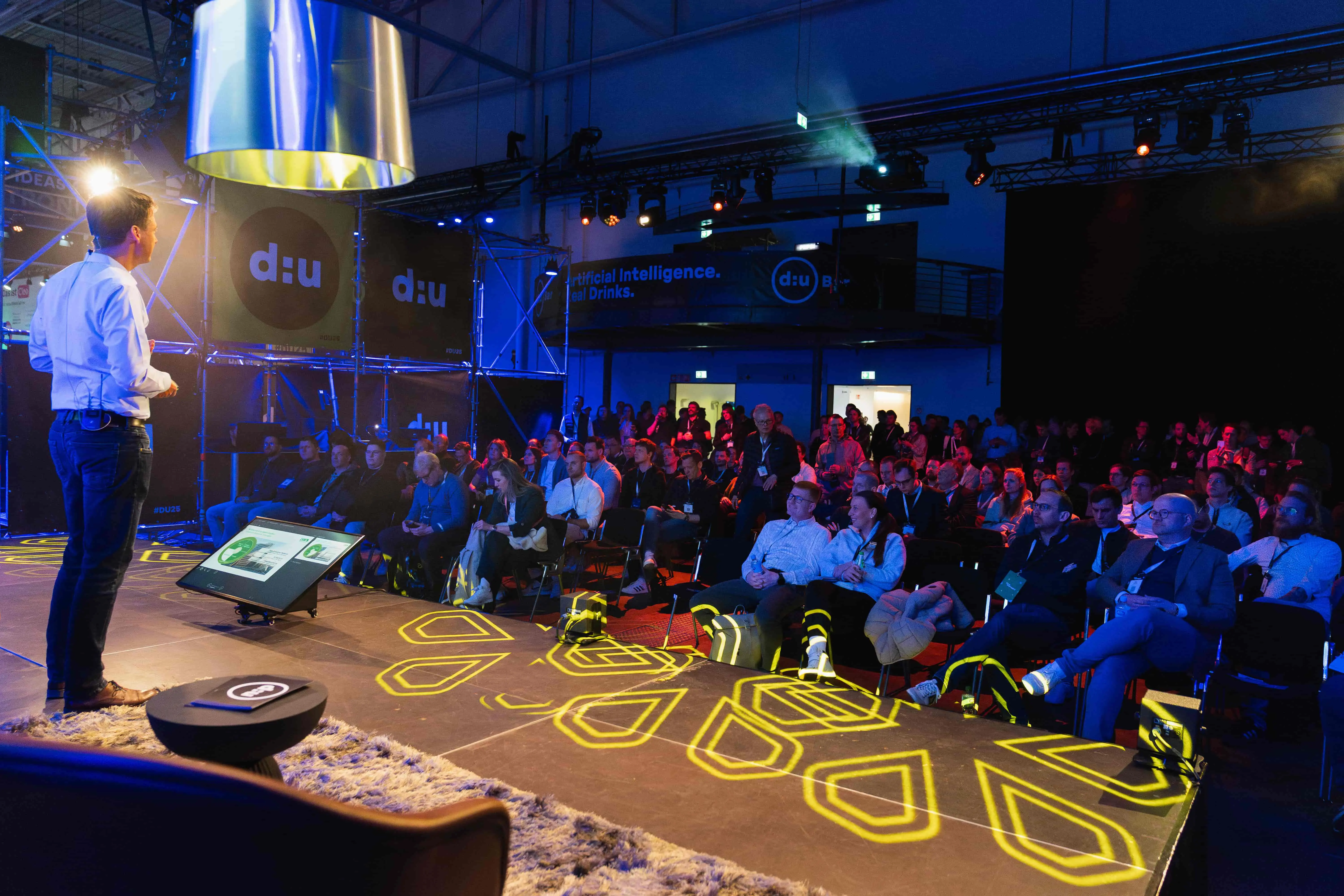
From our conversations with marketing leads in the Mittelstand, we know that it's exactly these kinds of practical accounts that actually move decisions forward – not studies, but concrete experience from comparable organisations. At d:u27 on 13 & 14 April 2027 in Münster, those accounts take centre stage.
Generative AI in marketing: what it can and can't do
Generative AI in marketing is not a universal solution. It's a tool with clear strengths and equally clear weaknesses.
Its strengths lie in the speed of content production, generating variations, adapting copy for different channels, creating imagery and producing first drafts. For creative work it can serve as a sparring partner – but it doesn't replace editorial judgement.
Its weaknesses are worth knowing: hallucinations – fabricated facts or sources – are a real risk. Content published without human quality control can damage both brand and trust. Equally important: brand voice and tone need to be actively managed – AI doesn't automatically adopt the style that fits a particular company.
The McKinsey study shows that companies successfully using AI in marketing keep both sides in view: the efficiency gains from AI and the building of brand and creative work. For the Mittelstand, where authenticity and personal customer relationships are often decisive differentiators, this matters.
For a broader view of which AI trends are shaping marketing, our article on AI trends 2026 gives a solid overview.
Where the boundary lies between efficiency gain and quality loss – and how companies maintain that balance in practice – is one of the central topics at d:u27 on 13 & 14 April 2027 in Münster. Marketing teams share the guardrails they've put in place internally and what's proved to work.
What companies should focus on when getting started
Many marketing departments start with the tool – and only then discover that the prerequisites are missing. The most important factors for a successful AI deployment in marketing:
Data quality comes before technology. AI doesn't improve bad data – it amplifies it. Before scaling personalisation or analysis, it's worth taking an honest look at your own data: is customer data complete, current and cleanly structured?
Clear use cases deliver more than comprehensive strategies. The Bitkom study shows that 35 per cent of companies cite a missing AI strategy as a challenge. That doesn't mean an elaborate strategy needs to come first – a clearly defined pilot with a measurable goal delivers more than diffuse experimentation.
Governance and quality control need to be sorted before broad rollout. Which AI tools can the team use? How is content reviewed before publication? Who is responsible when AI-generated content contains errors?
The team needs to be brought along. Seventy-six per cent of companies cite marketing automation as a growing trend according to Bitkom. Yet experience shows: AI tools introduced without team involvement frequently fail because of adoption problems. Training, clear communication about the purpose and involving marketers in tool selection are all decisive.
Conclusion
AI in marketing is a tool, not a shortcut
AI is changing how marketing teams work. Not because it replaces creative work, but because it speeds up routine processes, makes data legible and frees up capacity for the tasks that actually have impact: developing messages, understanding audiences, sharpening positioning.
For the Mittelstand, the opportunity lies not in automating everything at once. One clearly scoped use case, a clean data foundation and a team that understands and accepts the tools – these are the conditions under which AI in marketing genuinely delivers.
Those looking to take a concrete step forward in 2027 will find the right formats at d:u27 on 13 & 14 April in Münster – from masterclasses on specific use cases to direct exchange with marketing teams who have already made the transition. Save your ticket now.
FAQ
What rules does a marketing team need for generative AI?
Teams using generative AI in marketing should clarify which tools are approved, who signs off content and how brand voice and factual accuracy are maintained. Just as important is who is responsible when AI-generated content contains errors. These points should be settled before a broad rollout.
What do I need for AI-driven personalised marketing?
The most important prerequisite is clean data, for example complete and current customer data in your CRM. AI doesn't compensate for gaps in data quality, it amplifies what's already there. Fragmented customer data produces fragmented personalisation.
Can I publish AI-generated marketing copy without reviewing it?
That's not advisable. Hallucinations, meaning fabricated facts or sources, are a real risk, and content published without human quality control can damage both brand and trust. AI also doesn't automatically adopt the brand voice that fits your company.
Do I need a comprehensive AI strategy before using AI in marketing?
Not necessarily. According to Bitkom, 35 per cent of companies cite a missing AI strategy as a challenge, but a clearly defined pilot with a measurable goal often delivers more than diffuse experimentation. Data quality, governance and bringing the team along matter just as much.